
CCNP Service Provider Certification: Exams, Skills, Cost, and How to Prepare
What Is CCNP Service Provider?
CCNP stands for Cisco Certified Network Professional. The Service Provider track sits between CCNA (associate) and CCIE Service Provider (expert) in Cisco's certification ladder. It targets the technologies that differentiate a carrier network from an enterprise network: large-scale IGP and BGP design, MPLS and segment routing, Layer 2 and Layer 3 VPN services, quality of service, high availability, multicast, and model-driven automation.
Cisco's own description of the skills a CCNP Service Provider holder demonstrates includes:
-
Troubleshooting routing protocols at scale
-
Implementing high availability
-
Implementing MPLS
-
Implementing multicast and QoS services
-
Automating network configuration
-
Implementing routing policy language (RPL) and route maps
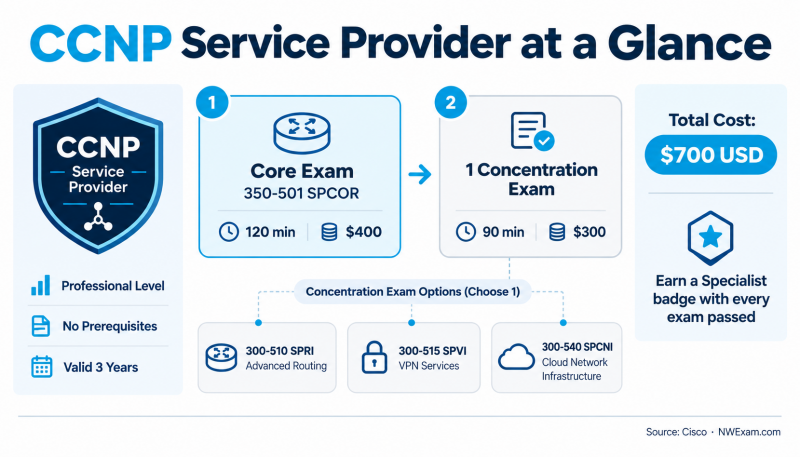
Unlike older Cisco tracks, every exam you pass on the way to CCNP Service Provider also earns you a standalone Cisco Certified Specialist badge. Pass SPCOR and you immediately hold Cisco Certified Specialist – Service Provider Core, even before you sit the concentration exam.
CCNP Service Provider Exam Structure
The certification requires two exams: the mandatory core exam plus one concentration exam. All exams are pass/fail, graded online within 48 hours, and have no prerequisites.
-
300-510: Implementing Cisco Service Provider Advanced Routing Solutions (SPRI)
-
300-515: Implementing Cisco Service Provider VPN Services (SPVI)
-
300-540: Designing and Implementing Cisco Service Provider Cloud Network Infrastructure (SPCNI)
-
350-501: Implementing and Operating Cisco Service Provider Network Core Technologies (SPCOR)
Total certification cost: $700 USD (one core + one concentration), excluding training and retakes. Cisco Learning Credits can also be used.
Note for candidates following older guides: the 300-535 SPAUTO automation concentration no longer appears on Cisco's current CCNP Service Provider page.
The Core Exam: 350-501 SPCOR
SPCOR is the heart of the certification and is shared with the CCIE Service Provider written qualification. It tests implementation of core service provider technologies across these domains:
-
Architecture – service provider network designs, virtualization (NFV, SDN concepts), data analytics and model-driven telemetry
-
Networking – OSPF, IS-IS, BGP, route redistribution, IPv6 transition, and high-availability features such as BFD and NSF/NSR
-
MPLS and Segment Routing – LDP, MPLS traffic engineering, segment routing fundamentals
-
Services – L2VPN and L3VPN basics, multicast, QoS classification, marking, queuing and policing
-
Automation and Assurance – NETCONF/RESTCONF, YANG models, Python-based configuration, telemetry, and network assurance tooling
-
Security – control-plane and management-plane protection on IOS XR and IOS XE
Expect a mix of multiple-choice, drag-and-drop, and scenario-based questions that show IOS XR configuration output and ask you to interpret or troubleshoot it.
Choosing Your Concentration Exam
Pick the concentration that matches the work you already do or want to move into.
-
300-510 SPRI (Advanced Routing) – Deepest dive into IGP and BGP scaling, routing policy language, MPLS, and segment routing. Best for backbone and core engineers.
-
300-515 SPVI (VPN Services) – Focuses on delivering Layer 2 VPNs (EVPN, VPLS, pseudowires), Layer 3 MPLS VPNs, and IPv6 VPN services. Best for engineers in a service delivery or provisioning role.
-
300-540 SPCNI (Cloud Network Infrastructure) – Covers virtualized architecture, cloud interconnect, high availability, security, and service assurance. Best for engineers working where carrier networks meet public and private cloud.
Many candidates choose SPRI first because its topics overlap heavily with SPCOR, which shortens total study time.
Who Should Earn CCNP Service Provider?
This certification is designed for professionals in roles such as:
-
Service provider network engineer or NOC engineer
-
Core, backbone, or transport network engineer
-
MPLS or VPN services engineer
-
Network automation engineer at a carrier or large ISP
-
Systems engineer or consultant selling into telecom accounts
There are no formal prerequisites, but Cisco recommends three to five years of experience implementing service provider solutions. A CCNA or equivalent knowledge of routing, switching, and IP fundamentals is a sensible foundation before you start SPCOR.
Validity and Recertification
CCNP Service Provider is valid for three years. You can renew by passing qualifying exams before expiry (any core, concentration, or CCIE written exam counts) or by earning Continuing Education credits through Cisco U., Cisco Live sessions, and approved training. Many engineers combine the two: one concentration exam plus a smaller number of CE credits.
How to Prepare for CCNP Service Provider Certification Exam?
-
Start with the official exam topics. Download the SPCOR blueprint from the Cisco Learning Network and map each topic to your current confidence level. Spend your time where you score lowest.
-
Build an IOS XR lab. Service provider exams lean on IOS XR syntax. Use Cisco Modeling Labs, XRd containers, or the Cisco DevNet sandboxes to practice MPLS, BGP route reflection, segment routing, and L3VPN configuration end to end.
-
Use Cisco's official training. Cisco U. offers a guided CCNP Service Provider learning path, and instructor-led SPCOR and concentration courses are available through Cisco Learning Partners.
-
Read Cisco Press and RFC-level material. For SPCOR and SPRI especially, understanding why BGP attributes or MPLS labels behave as they do matters more than memorizing commands.
-
Practice with timed mock exams. The 120-minute SPCOR exam rewards pacing. Taking full-length practice tests under exam conditions, such as the CCNP Service Provider practice tests on NWExam.com, helps you learn the question style, find weak domains, and build the stamina the real exam demands.
-
Schedule the core exam first. Passing SPCOR earns a Specialist badge immediately and gives you momentum for the concentration exam.
A realistic timeline for a working engineer is 10 to 14 weeks for SPCOR and 6 to 8 weeks for a concentration exam.
Salary and Career Outlook
CCNP-level engineers in service provider environments are consistently among the better-paid network roles because the skill set, particularly IOS XR, MPLS, segment routing, and automation, is scarcer than enterprise routing and switching. Compensation varies widely by region and employer, so treat salary surveys as directional. What the certification reliably does is open interviews at carriers, cloud providers, and large system integrators, and it is the required stepping stone toward CCIE Service Provider.
Final Thoughts
CCNP Service Provider remains the most direct way to prove carrier-grade networking skill on Cisco platforms. With a clear two-exam path, no prerequisites, a Specialist badge after your first pass, and three concentration options that match real job roles, it fits both experienced backbone engineers and ambitious NOC staff ready to move up. Start with the SPCOR blueprint, lab everything on IOS XR, test yourself under exam conditions, and book the core exam as soon as your practice scores are consistently strong.
Frequently Asked Questions
1. How many exams are required for CCNP Service Provider?
Two: the 350-501 SPCOR core exam and one concentration exam (300-510 SPRI, 300-515 SPVI, or 300-540 SPCNI).
2. Is CCNA required before CCNP Service Provider?
No. Cisco lists no prerequisites, though CCNA-level knowledge is strongly recommended.
3. How much does CCNP Service Provider cost?
$400 for SPCOR plus $300 for the concentration exam, for a total of $700 USD before training or retakes.
4. How long is the certification valid?
Three years. Renew with qualifying exams, Continuing Education credits, or a combination.
5. Does SPCOR count toward CCIE Service Provider?
Yes. SPCOR is the written qualifying exam for the CCIE Service Provider lab.
- Cisco Certification |
- Cisco CCNP Service Provider Certification |
- CCNP Service Provider Study Guide |
- CCNP Service Provider |
- 350-501 CCNP Service Provider |
- 350-501 |
- Implementing and Operating Cisco Service Provider Network Core Technologies |
- 300-510 CCNP Service Provider |
- 300-510 |
- Cisco SPRI Questions |
- Implementing Cisco Service Provider Advanced Routing Solutions |
- 300-515 CCNP Service Provider |
- 300-515 |
- Implementing Cisco Service Provider VPN Services |
- 300-540 CCNP Service Provider |
- 300-540 |
- Designing and Implementing Cisco Service Provider Cloud Network Infrastructure


