
Cisco Certification Guide: Levels, Tracks, Costs and Renewal

A Cisco Certification is still one of the fastest ways to prove you can build, secure and troubleshoot real networks. Hiring managers recognise the names CCNA, CCNP and CCIE without needing an explanation, and that recognition is what turns a line on your CV into an interview.
The programme has changed a lot in the past year, though. DevNet became Automation, CyberOps became Cybersecurity, wireless got its own track, and a new CCNA exam arrives in February 2027. If you last looked at the Cisco roadmap two years ago, it will look unfamiliar today.
This guide walks you through the current Cisco Certification levels, the technology tracks, what each exam costs, how renewal works and how to choose and prepare for your first (or next) exam.
What is a Cisco Certification?
A Cisco Certification is a vendor credential that confirms you have passed one or more proctored exams on networking, security, automation or related technologies. Written exams are delivered through Pearson VUE, either at a test centre or online, while expert-level lab exams are run by Cisco itself.
Three things make it worth the effort:
-
Employer recognition. Cisco equipment runs a large share of enterprise and service provider networks, so the skills transfer directly to the job.
-
A clear ladder. Each level builds on the one below, so you always know what comes next.
-
Role-based tracks. You can specialise in the area you actually work in instead of studying everything.
Cisco Certification levels: entry to expert
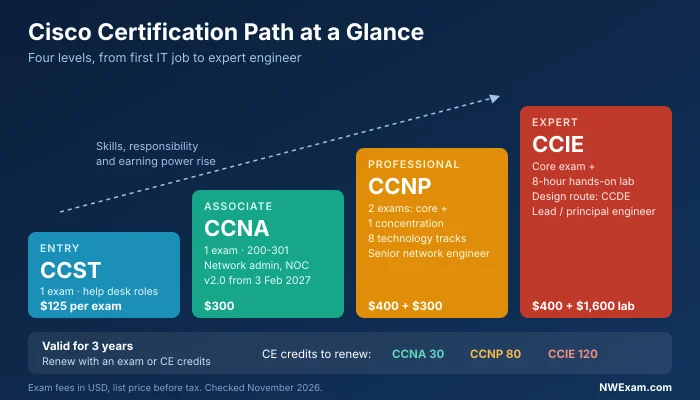
Cisco arranges its certifications in four levels. You do not have to start at the bottom, because there are no formal prerequisites for CCNA or CCNP, but most people climb in order.
Entry: CCST
Cisco Certified Support Technician (CCST) is the starting point for students and career changers. It comes in three flavours: Networking (100-150), Cybersecurity (100-160) and IT Support (100-140). Each is a single exam that checks you understand the basics well enough for a help desk or junior support role.
Associate: CCNA
CCNA is the certification most people mean when they say "Cisco certified". One exam, 200-301, covers network fundamentals, IP connectivity, security basics and automation in 120 minutes. Two sister certifications sit at the same level: CCNA Cybersecurity (200-201) for security operations and CCNA Automation (200-901) for network programmability.
Professional: CCNP
Every CCNP needs two passes: one core exam for your chosen track and one concentration exam that you pick from a short list. The core exam proves breadth, the concentration proves depth in a topic such as advanced routing, SD-WAN, firewalls or data centre automation. Each exam you pass also earns a Specialist certification on its own.
Expert: CCIE and CCDE
CCIE is the hands-on summit. You first pass the core exam for your track, then sit an eight-hour practical lab where you design, deploy, operate and optimise a complex network. CCDE is the design-focused equivalent, with a written exam followed by a scenario-based practical.
Cisco Certification tracks: pick your technology
At professional level you choose a track. Each has its own core exam, which also counts as the qualifying exam for the matching CCIE lab.
|
CCNP track |
Core exam |
Best suited to |
|---|---|---|
|
Enterprise |
350-401 ENCOR |
Campus and WAN engineers working with routing, switching and SD-WAN |
|
Wireless |
350-101 WLCOR |
Engineers who design and run Wi-Fi networks |
|
Security |
350-701 SCOR |
Firewall, VPN, identity and secure access specialists |
|
Cybersecurity |
350-201 CBRCOR |
SOC analysts, incident responders and threat hunters |
|
Data Center |
350-601 DCCOR |
Teams running ACI, Nexus and data centre fabrics |
|
Service Provider |
350-501 SPCOR |
Carrier and ISP engineers working with MPLS and segment routing |
|
Collaboration |
350-801 CLCOR |
Voice, video and contact centre engineers |
|
Automation |
350-901 AUTOCOR |
Network developers and NetDevOps engineers |
What changed in the Cisco Certification programme
If you are returning to Cisco after a break, these are the changes to know:
-
DevNet is now Automation. Since 3 February 2026 the DevNet Associate, Professional and Expert certifications are called CCNA, CCNP and CCIE Automation. Existing holders were moved across automatically.
-
CyberOps is now Cybersecurity. The security operations track was renamed CCNA Cybersecurity and CCNP Cybersecurity in early 2026, with refreshed exam content.
-
Wireless has its own track. CCNP Wireless and CCIE Wireless launched with first testing on 19 March 2026, replacing the wireless concentrations inside CCNP Enterprise.
-
A new CCNA is coming. CCNA 200-301 v2.0 goes live on 3 February 2027. The last day to sit the current v1.1 exam is 2 February 2027. The exam number stays the same, but v2.0 puts more weight on troubleshooting, security, automation and AI.
-
AI is showing up everywhere. New exams such as 300-640 DCAI in the Data Center track and AI topics across the refreshed blueprints reflect how networks are now built and operated.
Already studying for CCNA? Cisco's own advice is to carry on and sit v1.1 before the cut-off, because what you learn carries straight into v2.0.
How much does a Cisco Certification cost?
Exam fees rise with each level. These are Cisco's list prices in US dollars, before local taxes:
|
Level |
Exam |
Fee (USD) |
|---|---|---|
|
Entry |
CCST (each exam) |
$125 |
|
Associate |
CCNA, CCNA Cybersecurity, CCNA Automation |
$300 |
|
Professional |
CCNP core exam (350-xxx) |
$400 |
|
Professional |
CCNP concentration exam (300-xxx) |
$300 |
|
Expert |
CCDE written exam (400-007) |
$450 |
|
Expert |
CCIE lab or CCDE practical |
$1,600 |
So a CCNP costs $700 in exam fees if you pass both exams first time, and a CCIE costs $2,000 for the core exam plus the lab. Every retake is charged at the full fee, which is the best argument for not booking until your practice scores are consistently high.
How long is a Cisco Certification valid?
Associate, Specialist, Professional and Expert certifications are active for three years. Before the expiry date you can renew in one of three ways:
-
Pass a qualifying exam at the same or a higher level.
-
Earn Continuing Education (CE) credits through approved training and events.
-
Combine an exam with a smaller number of CE credits.
The credits needed for a credits-only renewal are:
|
Level |
CE credits needed |
|---|---|
|
Associate (CCNA) |
30 |
|
Specialist |
40 |
|
Professional (CCNP) |
80 |
|
Expert (CCIE, CCDE) |
120 |
CE credits cannot be used to renew CCST. Passing a higher-level exam renews everything below it, so moving up the ladder is often the most efficient way to stay certified.
How to choose the right Cisco Certification
Match the certification to where you are now, not where you hope to be in ten years:
-
New to IT or still studying: start with CCST Networking or CCST Cybersecurity to build confidence and vocabulary.
-
Up to two years in a support or junior network role: go for CCNA. It opens the most doors for the least outlay.
-
Working in a SOC or aiming for one: CCNA Cybersecurity is the closer fit.
-
Three to five years of hands-on networking: choose the CCNP track that mirrors your daily work. Enterprise is the most common choice.
-
Writing scripts and working with APIs: CCNA or CCNP Automation proves skills that pure network engineers often lack.
-
Senior engineer who wants to lead designs or deployments: plan for CCIE or CCDE, and give yourself 12 to 18 months.
How to prepare for a Cisco Certification exam
A plan that works for most candidates looks like this:
-
Download the exam topics. Cisco publishes a blueprint for every exam. Treat it as your checklist and check which version is live on your test date.
-
Learn the theory. Use an official cert guide, Cisco U. courses or instructor-led training, and take notes against each blueprint item.
-
Get hands-on. Build labs in Packet Tracer, Cisco Modeling Labs or on spare kit. Cisco exams reward people who have typed the commands.
-
Test yourself under exam conditions. Timed practice exams show you how the questions are worded, where you run out of time and which topics still need work.
-
Close the gaps, then book. Revisit weak areas until your practice scores are steady, and only then schedule the real exam.
NWExam.com helps with step four. You can try free sample questions for your exam, then move on to timed full-length and mini practice exams that follow the official exam format. Each attempt ends with a score report, so you can see exactly which topics to revise before paying the exam fee.
Cisco Certification FAQs
Which Cisco Certification should a beginner take first?
CCNA is the best first target for anyone with basic networking knowledge. If you are completely new to IT, CCST Networking is a gentler and cheaper first step at $125.
Do I need CCNA before CCNP?
No. Cisco removed formal prerequisites, so you can book a CCNP core exam directly. In practice, the CCNA syllabus is assumed knowledge, and skipping it makes CCNP much harder.
Should I take CCNA now or wait for v2.0?
If you have already started studying, sit the current v1.1 exam by 2 February 2027. If you are starting from zero and cannot be ready by then, study from the v2.0 exam topics from day one.
How long does it take to prepare?
Most candidates need three to six months of steady study for CCNA and a similar period for each CCNP exam. CCIE usually takes a year or more on top of solid professional experience.
Does a Cisco Certification expire?
Yes, after three years. You renew by passing a qualifying exam, earning Continuing Education credits or a mix of both.
Start your Cisco Certification journey
A Cisco Certification rewards a simple approach: choose the level that fits your experience, pick the track that matches your job, study against the official exam topics and test yourself honestly before exam day. With the CCNA refresh landing in February 2027, now is a good moment to set a date and work towards it.
When you are ready to check your readiness, explore the Cisco practice exams on NWExam.com and see how you score before you book the real thing.


