
Forget Memorization: Pass Fortinet NSE7_SSE_AR-26 Smarter
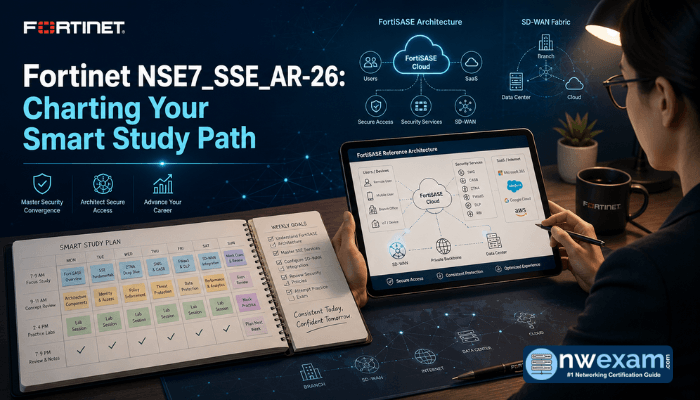
The Fortinet NSE 7 - SASE 26 Architect (NSE7_SSE_AR-26) certification validates an individual's advanced knowledge and skills in designing, implementing, and managing Fortinet's Secure Access Service Edge (SASE) solution architecture. This credential is vital for network architects, security engineers, and IT professionals seeking to demonstrate their expertise in securing modern distributed networks and cloud environments. It focuses on practical application, moving beyond rote memorization to assess a candidate's ability to architect and operationalize FortiSASE. This comprehensive guide will explore the exam's structure, syllabus domains, effective study strategies, and the significant professional benefits of achieving this specialized Fortinet NSE 7 certification.
Validating SASE Architecture Expertise
Achieving the Fortinet NSE7_SSE_AR-26 certification demonstrates a professional’s ability to design and implement complex SASE solutions using Fortinet technologies such as FortiSASE and SD-WAN. It validates important role-specific skills needed to provide secure, scalable, and high-performance access to applications and data. The certification also prepares professionals to address challenges such as distributed workforce security, cloud application access, and unified threat management across diverse network environments. They become instrumental in ensuring robust security postures and streamlined network operations for organizations adopting SASE frameworks. The certification directly reflects a candidate's ability to integrate security and networking functionalities seamlessly within a Fortinet ecosystem.
Architecting Resilient FortiSASE Deployments
Modern enterprises demand robust SASE architectures that can adapt to evolving threats and business needs. The Fortinet NSE 7 - SASE 26 Architect certification verifies your proficiency in building such resilient systems. This involves not only understanding individual components but also their synergistic operation within a holistic SASE framework. Candidates learn to implement secure user access, apply granular traffic control, and ensure consistent policy enforcement across dispersed environments. The skills validated by this exam enable architects to anticipate potential vulnerabilities and design proactive security measures, significantly reducing organizational risk.
Strategic Role in Secure Network Evolution
IT professionals with the Fortinet NSE7_SSE_AR-26 credential play a strategic role in guiding their organizations through the transition to SASE models. Their expertise helps in mitigating the complexities of integrating diverse security and networking functionalities into a unified platform. This includes optimizing network performance, enhancing user experience, and reducing operational overhead through intelligent automation and centralized management. The certification confirms an architect’s ability to lead projects that transform traditional network perimeters into dynamic, cloud-delivered secure access services, contributing directly to an organization’s digital transformation journey.
Demystifying the Fortinet NSE7_SSE_AR-26 Exam Structure
Understanding the specific details of the Fortinet NSE 7 - SASE 26 Architect (NSE7_SSE_AR-26) exam is the first step toward effective preparation. This information provides a clear roadmap of what to expect on exam day, helping candidates manage their time and focus their study efforts appropriately. Familiarity with these logistical aspects can alleviate exam-day anxiety and allow you to concentrate fully on the technical challenges presented.
The exam details are structured as follows:
-
Exam Name: Fortinet NSE 7 - SASE 26 Architect
-
Exam Code: NSE7_SSE_AR-26
-
Duration: 70-80 minutes
-
Number of Questions: 40-50
-
Passing Score: Pass / Fail
-
Exam Price: $200 USD
These parameters highlight that the exam is a focused assessment, requiring quick and accurate decision-making. The pass/fail scoring emphasizes a comprehensive understanding of the material rather than achieving a specific numerical threshold, pushing candidates to master all domains thoroughly.
Navigating the FortiSASE Architect Syllabus
The Fortinet NSE7_SSE_AR-26 exam syllabus outlines the critical knowledge domains and their respective weightages, providing a structured framework for your study plan. Each topic area is designed to test a candidate’s understanding of FortiSASE architecture, deployment, and management, alongside foundational SD-WAN concepts. A balanced approach to studying all domains, proportional to their emphasis, is crucial for success.
The key syllabus topics include:
-
SD-WAN architecture and deployment (10–20%): This section explains the fundamental concepts of Software-Defined Wide Area Networking (SD-WAN). It covers key design principles and deployment models. It also explains how SD-WAN integrates into a broader network strategy. Candidates need to understand how SD-WAN facilitates application-aware routing and optimizes traffic flow.
-
SD-WAN traffic control and IPsec (20–30%): A significant part of the exam focuses on managing traffic in an SD-WAN environment. It covers practical techniques for controlling and optimizing network traffic. This includes configuring advanced traffic steering policies, quality of service (QoS), and implementing robust IPsec VPNs for secure communication between sites and to the SASE cloud.
-
FortiSASE architecture and integration (15–25%): This domain delves into the core of Fortinet’s SASE solution. It covers the architectural components of FortiSASE, how it integrates with existing network infrastructure, and its role in delivering unified security and networking services from the cloud.
-
FortiSASE deployment and secure access (20–30%): This practical section examines the methods for deploying FortiSASE components and configuring secure access for users, devices, and remote locations. It includes understanding secure web gateway (SWG), cloud access security broker (CASB), and zero-trust network access (ZTNA) principles within the FortiSASE framework.
-
Centralized management, visibility, and troubleshooting (10–20%): The final domain emphasizes the operational aspects of managing a FortiSASE deployment. This involves utilizing centralized management platforms for policy enforcement, monitoring network and security events, and performing effective troubleshooting to ensure continuous service availability and performance.
Candidates must immerse themselves in these areas, particularly those with higher weightings, to ensure a well-rounded and comprehensive preparation. A deep understanding of each component is essential. You should know its function and how it interacts with the Fortinet SASE ecosystem. This knowledge is important for answering scenario-based questions effectively.
Cultivating a Strategic Study Approach for Fortinet NSE7_SSE_AR-26
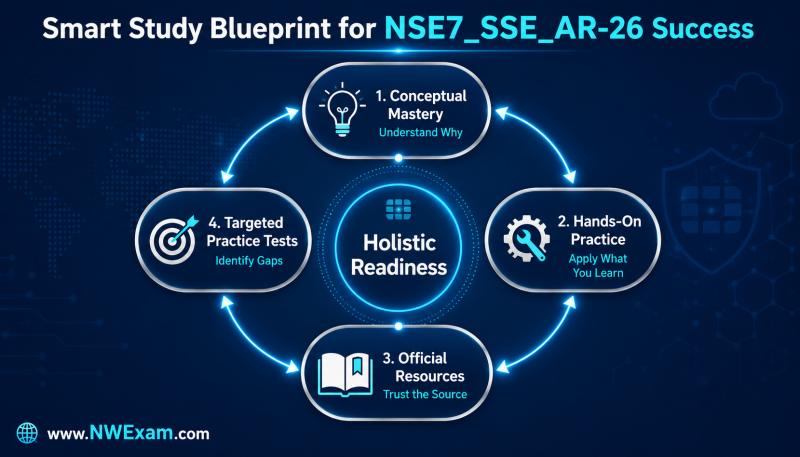
Effective preparation for the Fortinet NSE7_SSE_AR-26 exam demands more than just casual reading; it requires a strategic, multi-faceted approach. Forget mere memorization of terms and instead focus on understanding the underlying principles and practical applications of FortiSASE and SD-WAN technologies. This exam is designed for architects, meaning it tests your ability to design and troubleshoot, not just recall facts. A smart study plan integrates official documentation, hands-on labs, and targeted practice to build a robust knowledge base.
Understanding Core Concepts vs. Rote Learning
The Fortinet NSE 7 - SASE 26 Architect exam assesses your capacity to apply knowledge in real-world scenarios. Therefore, simply memorizing definitions or command syntax will likely fall short. Instead, strive for a profound understanding of why certain architectural decisions are made, how different components interact, and the implications of various configurations. For instance, when studying SD-WAN traffic control, understand not just *what* QoS is, but *why* specific QoS policies are chosen for different application types and *how* they impact overall network performance and user experience. This conceptual mastery will empower you to tackle complex problem-solving questions.
Leveraging Official Fortinet Resources
Fortinet provides a wealth of official resources that are indispensable for NSE7_SSE_AR-26 preparation. These include detailed product documentation, configuration guides, and potentially recommended training courses. These resources offer the most accurate and up-to-date information directly from the vendor, which is critical for an exam focused on proprietary technologies. Make sure to explore the official Fortinet NSE 7 - SASE 26 Architect exam page for the latest updates, recommended training paths, and any associated materials. Engaging with these resources ensures your study aligns precisely with the exam objectives.
Hands-On Experience: The Cornerstone of NSE7_SSE_AR-26 Readiness
Theoretical knowledge, while important, can only take you so far in an architect-level certification like the Fortinet NSE7_SSE_AR-26. Practical, hands-on experience with FortiSASE components and Fortinet SD-WAN solutions is paramount. Configuring devices, troubleshooting issues, and implementing various architectural designs in a lab environment solidify your understanding and prepare you for the real-world scenarios presented in the exam. This practical engagement transforms abstract concepts into tangible skills, building confidence and competence.
Establishing a lab environment, whether virtual or physical, is highly recommended. This allows you to:
-
Configure FortiGate SD-WAN: Practice setting up interfaces, creating zones, configuring link health monitoring, and implementing basic and advanced SD-WAN rules. Experiment with different traffic steering methods based on application requirements.
-
Implement IPsec VPNs: Build site-to-site and hub-and-spoke IPsec VPN tunnels, focusing on phase 1 and phase 2 negotiations, encryption algorithms, and authentication methods. Understand how to troubleshoot common VPN connectivity issues.
-
Explore FortiSASE Components: If possible, gain access to FortiSASE demos or trial environments. Understand the FortiSASE console, policy configuration, secure web gateway functions, and cloud access security broker features.
-
Practice Centralized Management: Familiarize yourself with FortiManager for centralized policy deployment, monitoring, and reporting across multiple FortiGates and potentially FortiSASE instances.
-
Simulate Troubleshooting Scenarios: Intentionally misconfigure settings or create network issues in a lab environment. Use Fortinet diagnostic tools and logs to identify and resolve these problems. This practice helps strengthen your troubleshooting skills.
This active learning approach, where you apply concepts directly, will embed the knowledge far more effectively than passive study alone. It helps you understand the nuances of deployment and the potential challenges in securing complex, distributed environments.
Boosting Confidence with Fortinet NSE7_SSE_AR-26 Practice Questions
Beyond theoretical and practical study, an essential component of smart exam preparation is leveraging high-quality Fortinet NSE7_SSE_AR-26 practice questions. These resources serve as a critical self-assessment tool, allowing you to gauge your understanding, identify knowledge gaps, and become familiar with the exam format and question styles. They bridge the gap between knowing the material and being able to apply it under timed, exam-like conditions.
Using practice questions effectively involves more than just answering them. It requires a detailed review of both correct and incorrect answers. For every question you get wrong, delve into why it was incorrect and revisit the associated syllabus topic. Similarly, for correct answers, ensure you fully understand the reasoning behind them, reinforcing your knowledge. This iterative process of practice, review, and re-study is highly effective for deepening comprehension and improving retention. Quality practice exams, like those found on NWExam, can significantly enhance your preparation strategy. They provide realistic scenarios that mimic the actual exam experience, helping to build confidence and refine your test-taking skills.
Mastering Advanced SD-WAN and FortiSASE Deployment Scenarios
The Fortinet NSE7_SSE_AR-26 exam places considerable emphasis on advanced deployment scenarios for both SD-WAN and FortiSASE. These aren't just about knowing individual features; they involve understanding how these features integrate and perform under various network conditions. Successful candidates must understand traffic control mechanisms and security policies. They should also understand key architectural choices. These skills help optimize performance and security in modern, distributed enterprise environments.
Optimizing SD-WAN Traffic Control for Diverse Applications
A key aspect of mastering SD-WAN is implementing intelligent traffic control. This includes deep dives into application identification, service level agreements (SLAs), and dynamic path selection. Architects need to configure SD-WAN rules that prioritize critical business applications, route traffic over the most performant links, and ensure redundancy. This involves understanding the implications of different routing protocols within an SD-WAN fabric and how to integrate them with existing network infrastructure. For example, knowing when to use performance-based routing versus cost-based routing is crucial.
Securing Cloud Access with FortiSASE Capabilities
FortiSASE deployment for secure access involves configuring comprehensive security policies for users connecting to cloud applications and internet resources. This encompasses understanding the role of Secure Web Gateway (SWG) for content filtering and threat protection, Cloud Access Security Broker (CASB) for SaaS application visibility and control, and Zero Trust Network Access (ZTNA) for granular access to private applications. Candidates should be able to design a FortiSASE implementation that enforces consistent security policies, regardless of where users are located or which devices they are using. This demands knowledge of user and device authentication, posture checks, and the enforcement of least-privilege access principles. Understanding the nuances of these integrations is vital for practical application. More information on FortiSASE architecture can be found on the Fortinet FortiSASE Architect exam overview page.
Ensuring Optimal Visibility and Troubleshooting in SASE Environments
Maintaining operational integrity and security in a FortiSASE environment requires robust visibility and efficient troubleshooting capabilities. The Fortinet NSE7_SSE_AR-26 exam tests your ability to not only deploy these complex solutions but also to manage and maintain them post-deployment. This includes understanding how to leverage centralized management tools to monitor network health, detect anomalies, and swiftly resolve issues that may arise in a distributed SASE architecture.
Effective visibility means clearly monitoring network traffic and security policies. It also involves tracking the status of all SASE components. A single management interface can provide this centralized view. This involves using dashboards, reports, and logs provided by Fortinet management platforms. Troubleshooting, on the other hand, demands a systematic approach to identify the root cause of performance degradation or security incidents. This section of the exam will challenge your diagnostic skills, requiring you to interpret data, trace network paths, and apply logical problem-solving techniques. Candidates should be proficient in using FortiManager for monitoring, FortiAnalyzer for logging and reporting, and command-line interfaces (CLI) for granular diagnostics on FortiGate devices integrated into the SASE fabric.
The Professional Advantage: Benefits of Fortinet FortiSASE Architect Certification
Earning the Fortinet NSE 7 - SASE 26 Architect certification provides a strong advantage in today’s evolving cybersecurity and networking landscape. It validates your expertise in designing and implementing advanced SASE solutions. The certification can support career growth and demonstrate in-demand skills. It also positions you as a skilled professional in building future-ready network security architectures.
-
Enhanced Career Opportunities: The demand for skilled SASE architects is growing exponentially. Holding the NSE7_SSE_AR-26 certification opens doors to senior roles in network architecture, cybersecurity engineering, and cloud security, making you a highly attractive candidate for leading organizations.
-
Industry Recognition: Fortinet is a global leader in cybersecurity, and its NSE certifications are widely respected. Achieving an NSE 7 level designation signifies deep expertise and commitment to professional development, distinguishing you among your peers.
-
Validation of Advanced Skills: This certification specifically validates your ability to architect, integrate, deploy, and manage FortiSASE and SD-WAN solutions. These are complex, multi-faceted skills that are critical for protecting modern enterprise networks against sophisticated threats.
-
Increased Earning Potential: Specialized certifications often correlate with higher salaries. The expertise validated by NSE7_SSE_AR-26 is in high demand, allowing certified professionals to command competitive compensation packages.
-
Contribution to Organizational Security: As a FortiSASE Architect, you directly contribute to strengthening an organization’s security posture. Your ability to design resilient, efficient, and secure SASE architectures helps protect valuable assets, ensure business continuity, and maintain compliance with regulatory requirements.
-
Staying Ahead of the Curve: SASE represents the convergence of networking and security into a cloud-delivered service model, making it a critical area for future-proof IT infrastructure. By becoming certified, you demonstrate proactive engagement with cutting-edge technologies.
This certification is a valuable investment in your career. It builds the skills needed to manage and secure complex digital environments. It also prepares you for the security challenges of the future.
Avoiding Common Pitfalls in NSE7_SSE_AR-26 Exam Preparation
While focusing on study strategies, it is equally important to be aware of common pitfalls that can derail your Fortinet NSE7_SSE_AR-26 exam preparation. Successfully navigating this architect-level certification involves not just acquiring knowledge, but also adopting smart study habits and ethical practices. Steering clear of these traps will ensure your efforts are productive and lead to genuine understanding.
Emphasizing Ethical Study and Resource Selection
One significant pitfall is relying on unethical or outdated study materials, often referred to as "dumps." These resources provide memorized questions and answers without fostering true understanding, leading to a superficial grasp of the concepts. Not only is using such materials unethical, but it also prepares you poorly for the adaptive and scenario-based questions typical of advanced certifications. Focus on official Fortinet documentation, approved training courses, and reputable practice questions that explain the reasoning behind answers. Genuine learning ensures you are truly prepared for the challenges of an architect role, not just the exam itself.
Effective Time Management and Consistent Review
Another common mistake is inconsistent study or cramming. The breadth and depth of the NSE7_SSE_AR-26 syllabus demand a disciplined approach to time management. Create a realistic study schedule and adhere to it consistently. Allocate dedicated time slots for each syllabus domain, ensuring adequate coverage based on its weighting. Regular review sessions are crucial for reinforcing learned material and preventing knowledge decay. Breaking down complex topics into smaller, manageable chunks makes the study process less overwhelming and more effective. It’s better to study for shorter, focused periods regularly than long, infrequent, and exhausting sessions.
The Fortinet NSE 7 - SASE 26 Architect (NSE7_SSE_AR-26) certification signifies a deep understanding of FortiSASE architecture, SD-WAN implementation, and advanced security concepts crucial for modern network environments. Moving beyond basic memorization to embrace a smarter, application-focused study approach is key to mastering the complex topics. By leveraging official resources, gaining hands-on experience, and employing strategic practice questions, candidates can confidently prepare for an exam that validates true architectural proficiency. This credential not only enhances professional credibility but also positions individuals at the forefront of secure access service edge innovation.
To embark on your Fortinet NSE7_SSE_AR-26 certification journey, explore comprehensive study materials and practice tests available to solidify your understanding. A dedicated approach, combining theoretical knowledge with practical application, will equip you with the expertise to confidently pass the exam and elevate your career in cybersecurity architecture. Start your preparation today and unlock your potential with a recognized credential that truly makes a difference in the evolving world of SASE. Discover advanced study resources and practice questions to optimize your readiness for the Fortinet NSE 7 - SASE 26 Architect exam here.
Frequently Asked Questions
1. What does the Fortinet NSE7_SSE_AR-26 certification validate?
This certification validates an individual's advanced skills in designing, implementing, and managing Fortinet's Secure Access Service Edge (SASE) solutions, including FortiSASE and SD-WAN architecture.
2. Who should consider taking the Fortinet NSE 7 - SASE 26 Architect exam?
Network architects, security engineers, and cloud security specialists can benefit from this certification. It is also suitable for IT professionals who design and secure distributed networks. The certification focuses on implementing SASE solutions for modern network security.
3. What kind of preparation is most effective for the NSE7_SSE_AR-26 exam?
Effective preparation involves understanding core concepts, gaining hands-on experience with FortiSASE and SD-WAN technologies, studying official Fortinet documentation, and utilizing high-quality practice questions to solidify knowledge and identify gaps.
4. Is hands-on experience crucial for passing the Fortinet NSE7_SSE_AR-26 exam?
Yes, practical experience is highly crucial. The exam is designed for architects and tests the ability to apply knowledge in real-world scenarios, making hands-on configuration, deployment, and troubleshooting vital for success.
5. What are the career benefits of achieving the Fortinet NSE 7 - SASE 26 Architect certification?
The certification can improve career opportunities in cybersecurity architecture. It provides industry recognition and validates advanced, in-demand skills. It can also increase earning potential and help professionals become leaders in modern secure network transformation.
- Fortinet Secure Access Service Edge (SASE) Certification |
- NSE7_SSE_AR-26 FortiSASE Architect |
- NSE7_SSE_AR-26 |
- FortiSASE Architect Certification Mock Test |
- Fortinet FortiSASE Architect Certification |
- FortiSASE Architect Mock Exam |
- FortiSASE Architect Practice Test |
- Fortinet FortiSASE Architect Primer |
- FortiSASE Architect Question Bank |
- FortiSASE Architect Simulator |
- FortiSASE Architect Exam Questions |
- Fortinet FortiSASE Architect Questions |
- Fortinet NSE 7 - SASE Architect |
- Fortinet FortiSASE Architect Practice Test |
- NSE7_SSE_AR-26 Syllabus |
- FortiSASE Architect Books |
- FortiSASE Architect Certification Cost |
- FortiSASE Architect Certification Syllabus |
- Fortinet FortiSASE Architect Training |
- Fortinet NSE7_SSE_AR-26 Books |
- Fortinet FortiSASE Architect Books |
- FortiSASE Architect Sample Questions |
- Fortinet NSE7_SSE_AR-26 Practice Test Free |
- FortiSASE Architect Certification Questions and Answers |
- FortiSASE Architect Certification Sample Questions


