
How to Pass the Palo Alto Networks XDR Engineer Exam?

When a ransomware attack strikes an enterprise network, the situation can escalate within minutes. As alerts multiply and critical files become encrypted, security teams need immediate visibility into the threat landscape. Real-time monitoring, deep network insights, and automated response mechanisms are essential to contain the attack and minimize business disruption.
Securing modern enterprises requires advanced detection platforms and highly skilled engineers who know how to run them. The Palo Alto Networks XDR Engineer Exam validates your ability to deploy, configure, and maintain these crucial security environments.
Earning this certification proves you can safeguard infrastructure using state-of-the-art automation and behavioral analytics. If you want to build trust with employers and showcase your tactical defense skills, this guide is your blueprint. Let us explore exactly how to pass this exam and advance your engineering career.
What is the Palo Alto Networks XDR Engineer Exam?
The Palo Alto Networks XDR Engineer Exam is a technical certification designed for modern security professionals. It evaluates your deep technical knowledge of the Cortex XDR platform. This includes deployment strategies, agent installation, alert analysis, and proactive threat hunting workflows.
This test does not just ask you to memorize textbook terms. Instead, it places you in complex, real-world engineering scenarios where you must make architecture and optimization decisions. Candidates must understand how network, endpoint, and cloud logs converge into a unified dashboard.
To sit for this exam, you should ideally have experience operating enterprise security controls. Knowing your way around security operations centers (SOC) and incident response frameworks will give you a significant advantage. Passing this test awards you the title of a Palo Alto Networks certified XDR Engineer, proving your technical capability to peers globally.
For official updates on exam registration, policies, and requirements, visit the Palo Alto Networks XDR Engineer Training Page.
Core Syllabus Topics You Must Master
To succeed on this exam, you must align your study plan directly with the official curriculum. The blueprint spans several critical domains, ranging from baseline agent architecture to advanced multi-source data stitching.
To begin planning your preparation schedule, review the detailed breakdown on the NWExam Palo Alto XDR Engineer Exam Syllabus Page.
-
Planning and Installation
-
Cortex XDR Agent Configuration
-
Ingestion and Automation
-
Detection and Reporting
-
Maintenance and Troubleshooting
How to Study for the Palo Alto Networks XDR Engineer Certification?
Achieving the Palo Alto XDR certification requires combining theoretical knowledge with hands-on practice. Reading administration guides is helpful, but configuring the software yourself creates lasting practical knowledge.
Start by working in a dedicated sandbox environment. Practice deploying endpoints, deliberately triggering benign alerts, and walking through the remediation steps. If you do not have access to a corporate laboratory environment, look for official guided workshops.
Step-by-Step Palo Alto Networks XDR Engineer Exam Preparation Plan
Follow this clear guide to structure your study approach effectively over a 4-to-6 week period.
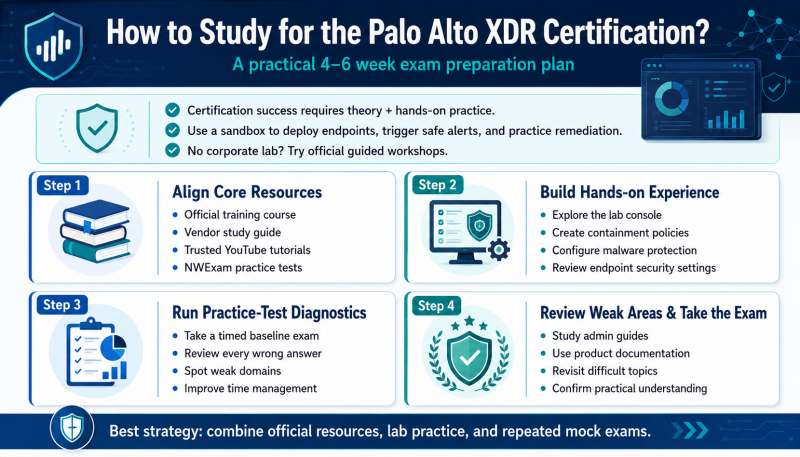
Step 1: Align Your Core Study Resources
Successful exam preparation starts with the official training course and the vendor’s recommended study guide, which provide comprehensive coverage of the exam objectives. Supplement your learning with legitimate YouTube tutorials from trusted instructors and official channels to reinforce key concepts and gain practical insights. Once you have built a solid foundation, use practice tests from NWExam to assess your readiness, identify knowledge gaps, and improve your confidence before exam day.
Step 2: Build Hands-on Practical Experience
Log into your test console or lab environment and spend time exploring the platform’s interface, navigation, and core security features. Practice creating and modifying custom containment policies to understand how threats can be isolated and controlled in different scenarios. Configure malware protection profiles, review policy settings, and observe how security controls are applied across endpoints and workloads.
Step 3: Run Diagnostics with Practice Tests
Take your first timed practice exam under realistic test conditions to establish a baseline of your current knowledge and exam readiness. Do not focus too much on achieving a high score during this initial attempt. Instead, use the results to identify weak areas, misunderstood concepts, and topics that require additional study. Carefully review every incorrect answer and understand why the correct option is right. Pay attention to patterns in your mistakes, whether they relate to specific domains, question formats, or time management. This analysis will help you create a targeted study plan and maximize your improvement in the weeks leading up to the actual exam.
Step 4: Review Weak Areas and Take the Exam
Review the official administrative guides and product documentation to strengthen your understanding of topics that remain unclear after your study sessions and practice exams. These resources often provide detailed explanations, configuration examples, and best practices that can help fill knowledge gaps. Revisit challenging exam domains and verify that you understand both the concepts and their practical applications.
Utilizing Practice Test Resources Wisely
To pass on your first attempt, you need to practice with high-quality sample materials. Working through realistic scenarios trains your mind to spot subtle clues hidden inside complex exam questions.
Using tools like a Palo alto networks xdr engineer practice test helps you get used to the pace of the actual exam. It teaches you how to manage your time effectively across multiple-choice questions and scenario analysis.
When searching for reliable study aids, be cautious of unreliable resources. Looking for shortcuts like a Palo alto networks xdr engineer test answers sheet or low-quality braindumps can leave you unprepared for the actual test. Focus instead on understanding the core logic behind the answers.
Using high-quality Palo alto networks xdr engineer exam questions teaches you how to analyze real situations. It ensures you know how to identify root causes and deploy proper security fixes.
Review high-quality sample materials by visiting the NWExam Palo Alto XDR Engineer Sample Questions Page. This resource helps you understand the reasoning behind the correct Palo alto networks xdr engineer answers.
Essential Tips for Palo Alto Networks XDR Engineer Exam Day Success
When exam day arrives, maintaining a calm, methodical mindset is just as important as your technical knowledge. Review these essential strategies to maximize your performance under pressure.
-
Read Every Scenario Carefully: The test often includes long scenario questions. Look for key details like operating system versions, strict firewall rules, or specific cloud architectures.
-
Use the Elimination Method: If you are not sure of the correct answer, eliminate the options that are clearly wrong first. This improves your chances of selecting the right option from the remaining choices.
-
Keep Track of Your Time: Do not let a single difficult question eat up ten minutes of your time. Flag it for review, move forward, and return to it later if time permits.
-
Watch for Specific Terms: Pay close attention to words like ALWAYS, NOT, or MOST APPROPRIATE. Missing these qualifiers can lead you to choose the wrong answer.
Conclusion
Passing the Palo Alto Networks XDR Engineer Exam takes dedication, consistent study, and hands-on practice. By breaking down the syllabus, exploring dashboards, and using realistic practice tests, you can master this exam.
This certification is more than just a line on your resume. It proves your ability to secure modern enterprises against complex, real-world cyber threats.
Start your preparation journey today. Check out the resources on NWExam.com to access high-quality practice exams and syllabus guides. Stay focused, practice consistently in the lab, and take your cybersecurity career to the next level!
Frequently Asked Questions
1. What is the passing score for the Palo Alto Networks XDR Engineer Exam?
Palo Alto Networks does not publish exact passing percentages for its technical exams. Scaled scoring models ensure that score calculations account for varying question difficulty across different test versions. Focus on scoring above 80% on high-quality practice exams before sitting for the official test.
2. Are there any prerequisites for taking this engineering test?
There are no strict formal prerequisites required before registering for this exam. However, having a strong understanding of core network security concepts and cloud logging environments is highly recommended. Many candidates find it helpful to earn their PCNSE certification first to build a solid baseline.
3. How long remains the Palo Alto XDR certification valid after passing?
The certification remains active for exactly two years from your official passing date. To maintain your certified status, you must pass the current version of the exam again or complete a higher-level recertification path before your credentials expire.
4. Can I rely entirely on test answers documents found online to clear the exam?
No, relying on simple answer lists is highly risky and often leads to exam failure. Real exam scenarios test your actual engineering logic and platform configuration skills. Using comprehensive practice questions to understand why an answer is correct is a much safer path to success.
5. How much time should I dedicate to preparing for this test?
Most working professionals need between 40 and 60 hours of total preparation time over a 4-to-6 week period. This schedule allows ample time to read through official guides, complete practice exams, and spend sufficient hours configuring settings in a live lab environment.
6. What happens if I fail the exam on my first attempt?
If you do not pass on your first attempt, you must wait 14 days before registering for a retake. Use this reflection window to review your score report, identify your weakest domains, and focus your study on those specific topics.
- XDR-Engineer |
- XDR-Engineer Certification Mock Test |
- XDR-Engineer Mock Exam |
- XDR-Engineer Practice Test |
- Palo Alto XDR-Engineer Primer |
- XDR-Engineer Simulator |
- XDR-Engineer Exam Questions |
- Palo Alto XDR-Engineer Questions |
- Palo Alto Networks XDR Engineer |
- Palo Alto XDR-Engineer Practice Test |
- Palo Alto Networks Certified XDR Engineer |
- XDR-Engineer Syllabus |
- XDR-Engineer Books |
- XDR-Engineer Certification Cost |
- XDR-Engineer Certification Syllabus |
- Palo Alto XDR-Engineer Training |
- Palo Alto XDR-Engineer Books |
- XDR-Engineer Sample Questions |
- Palo Alto XDR-Engineer Practice Test Free |
- XDR-Engineer Certification Questions and Answers |
- XDR-Engineer Certification Sample Questions


