
Skip the Panic: NSE5_FWF_AD-7.6 Is Simpler Than You Think

The Fortinet NSE 5 - Secure Wireless LAN 7.6 Administrator (NSE5_FWF_AD-7.6) exam validates a candidate's expertise in deploying, administering, and troubleshooting Fortinet Secure Wireless LAN solutions, focusing on the FortiGate and FortiAP platforms. This certification is crucial for network professionals responsible for designing, implementing, and maintaining secure wireless infrastructures. Achieving this credential demonstrates a robust understanding of wireless fundamentals, network security, and advanced diagnostics within the Fortinet ecosystem. This comprehensive article aims to demystify the preparation process for the NSE5_FWF_AD-7.6 exam, offering practical tips, study strategies, and confidence-building insights to help you approach it with clarity and success.
Understanding the NSE5_FWF_AD-7.6 Credential
The NSE 5 - Secure Wireless LAN 7.6 Administrator certification signifies a professional's ability to manage Fortinet's advanced wireless security solutions effectively. This includes handling various aspects of wireless network deployment, security enforcement, and operational management. The exam details outline a focused assessment of these critical skills, ensuring that certified individuals are well-equipped to protect modern wireless environments.
Here are the specific details for the NSE5_FWF_AD-7.6 examination:
-
Exam Code: NSE5_FWF_AD-7.6
-
Exam Name: Fortinet NSE 5 - Secure Wireless LAN 7.6 Administrator
-
Duration: 70 minutes
-
Number of Questions: 30-40
-
Passing Score: Pass / Fail
-
Exam Price: $200 USD
These parameters indicate that the exam is concise but demands a solid grasp of the subject matter, emphasizing practical knowledge and rapid problem-solving. Success requires not just theoretical understanding but also familiarity with Fortinet's implementation specifics. For more details on the certification and its benefits, you can explore the Fortinet NSE 5 - Secure Wireless LAN 7.6 Administrator overview.
Navigating Wireless LAN Core Competencies
The NSE5_FWF_AD-7.6 exam syllabus is structured to cover the essential aspects of secure wireless LAN administration, ensuring candidates possess a well-rounded skill set. It delves into the technical foundations of wireless technology and the specific functionalities of Fortinet products. Each topic area builds upon the previous, creating a holistic view of wireless network management and security.
The exam focuses on these key syllabus areas:
-
Wireless fundamentals and FortiAP management: This section assesses your understanding of fundamental wireless concepts, including Wi-Fi standards, RF principles, and Fortinet's specific approach to access point deployment and configuration. It covers how to effectively manage FortiAP devices within a FortiGate-controlled wireless environment.
-
Wireless network security and access: Security is paramount in wireless networks. This topic examines your ability to implement various security mechanisms, such as authentication protocols, encryption standards, and secure access policies. It ensures you can protect the wireless infrastructure from unauthorized access and potential threats.
-
Wireless monitoring and protection: Beyond initial setup, continuous monitoring is vital for maintaining a secure and high-performing wireless network. This segment tests your skills in monitoring wireless activity, identifying anomalies, and leveraging FortiGate features for intrusion prevention and threat detection specific to wireless traffic.
-
Wireless diagnostics and analytics: Troubleshooting and optimizing wireless networks require strong diagnostic capabilities. This final area evaluates your proficiency in using FortiGate and FortiAP tools to diagnose common wireless issues, analyze network performance, and generate reports for better operational insights.
A thorough understanding of these domains, coupled with hands-on experience, forms the backbone of successful preparation for the NSE5_FWF_AD-7.6 exam. Familiarity with the official Fortinet exam syllabus will further guide your study efforts.
Valuating Fortinet Wireless Expertise in Your Career
Earning the Fortinet NSE5_FWF_AD-7.6 certification provides tangible benefits, reinforcing your professional credibility and opening doors to enhanced career opportunities. This credential validates specialized skills that are highly sought after in today's security-conscious IT landscape, particularly in roles involving network administration, security engineering, and wireless infrastructure management. Professionals who hold this certification demonstrate a commitment to mastering secure wireless technologies, a critical component of modern enterprise networks.
The advantages extend beyond personal skill development:
-
Demonstrates Specialized Proficiency: The certification officially recognizes your ability to implement, manage, and troubleshoot Fortinet Secure Wireless LAN solutions, positioning you as a subject matter expert.
-
Enhances Career Trajectory: Certified individuals are often preferred for roles requiring advanced wireless security knowledge, leading to new opportunities and career advancement.
-
Boosts Organizational Security: Your expertise directly contributes to strengthening your organization's wireless security posture, mitigating risks, and ensuring robust network performance.
-
Industry Recognition: Fortinet is a leading cybersecurity vendor, and its certifications are globally recognized, signifying a high standard of technical competence.
-
Keeps Skills Current: Preparing for the exam ensures you are up-to-date with the latest wireless technologies and security best practices, crucial in a rapidly evolving field.
For a broader perspective on Fortinet's comprehensive security certifications, you can visit the official Fortinet training page. This credential ensures you are equipped with the skills needed to design and maintain robust wireless environments.
Crafting Your NSE5_FWF_AD-7.6 Preparation Strategy
A structured and disciplined approach is key to successfully passing the NSE5_FWF_AD-7.6 exam. Given the comprehensive nature of the syllabus, a strategic preparation plan will help you cover all topics effectively and build the necessary confidence. It's not just about memorizing facts, but understanding the underlying concepts and their practical application within the Fortinet ecosystem.
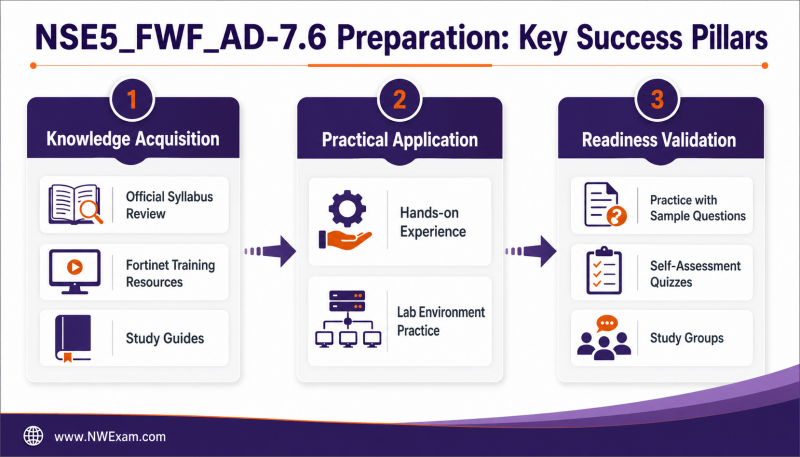
Consider these steps for a robust preparation strategy:
-
Review the Official Syllabus: Begin by thoroughly reviewing the official NSE5_FWF_AD-7.6 exam topics. Use this as your primary checklist to ensure all areas are covered. Identify your strengths and weaknesses early on.
-
Leverage Fortinet Training Resources: Fortinet offers official training courses designed to align directly with the exam objectives. These courses, whether instructor-led or self-paced, provide in-depth knowledge and hands-on labs crucial for practical understanding.
-
Acquire Hands-on Experience: Theoretical knowledge must be complemented by practical application. Set up a lab environment using FortiGate and FortiAP devices, or utilize virtual labs, to practice configurations, troubleshooting, and security implementations. This direct experience solidifies your understanding.
-
Utilize Study Guides and Books: Supplement official training with reputable study guides or technical documentation specific to Fortinet Secure Wireless LAN 7.6. These resources can offer alternative explanations and deepen your understanding of complex topics.
-
Practice with Sample Questions: To gauge your readiness and familiarize yourself with the exam format, practice with high-quality sample questions. This helps you identify areas needing further study and improves your time management during the actual exam. Engaging with realistic NSE5_FWF_AD-7.6 exam questions can significantly boost your confidence.
-
Join Study Groups or Forums: Collaborating with other candidates can provide new perspectives, clarify doubts, and keep you motivated. Online forums and study groups are excellent platforms for discussing challenging topics.
-
Schedule Consistent Study Sessions: Break down your study plan into manageable chunks. Regular, focused study sessions are more effective than sporadic cramming. Consistency reinforces learning and prevents burnout.
-
Prioritize Weak Areas: Once you identify your weaker syllabus topics through practice tests or self-assessment, dedicate extra time and resources to master them.
By integrating these components, you create a comprehensive and adaptable preparation strategy that addresses both the breadth and depth of the NSE5_FWF_AD-7.6 exam content.
Deep Diving into FortiAP Configuration and Management
The Fortinet NSE5_FWF_AD-7.6 exam places significant emphasis on the practical aspects of FortiAP configuration and overall wireless management. This involves more than just initial setup; it encompasses optimizing performance, ensuring seamless integration with FortiGate, and applying advanced settings for specific network requirements. A solid grasp of these operational details is crucial for anyone managing Fortinet wireless infrastructure.
Key areas to master include:
FortiAP Deployment Modes and Provisioning
Understanding the different modes in which FortiAPs can operate is fundamental. This includes thin AP mode (managed by a FortiGate), mesh mode for extending coverage, and standalone mode (less common for secure enterprise deployments).
-
Configuration Templates: Learning to use FortiGate's FortiAP profiles and configuration templates to standardize settings across multiple access points, simplifying management and ensuring consistency.
-
Initial Setup: Familiarity with initial FortiAP discovery, authorization, and provisioning procedures, whether through FortiGate's built-in WTP (Wireless Termination Point) controller or FortiManager.
Wireless Network Design and Optimization
Designing an effective wireless network involves careful planning to avoid interference, ensure adequate coverage, and maximize throughput.
-
RF Planning: Concepts like channel planning, power adjustments, and antenna selection to optimize signal strength and minimize co-channel interference.
-
SSID Configuration: Setting up multiple Service Set Identifiers (SSIDs) for different user groups (e.g., corporate, guest, IoT) with distinct security and QoS policies.
-
Client Load Balancing: Implementing features to distribute wireless clients evenly across access points and radios to prevent congestion and improve user experience.
Advanced FortiAP Features
Beyond basic connectivity, FortiAPs offer advanced functionalities that enhance security and network control.
-
Band Steering: Guiding client devices to the less congested 5 GHz band for better performance.
-
Airtime Fairness: Ensuring that all connected clients receive a fair share of airtime, preventing slower devices from monopolizing resources.
-
Rogue AP Detection: Configuring FortiGate and FortiAP units to detect unauthorized access points within your network environment, a critical security function.
Practical exercises involving the configuration of these features in a lab environment will be invaluable for the exam. This hands-on experience will not only reinforce theoretical knowledge but also prepare you for real-world scenarios.
Implementing Robust Wireless Security and Access Controls
Wireless network security is a cornerstone of the NSE5_FWF_AD-7.6 exam, demanding a thorough understanding of various mechanisms to protect data and control access. Given the inherent vulnerabilities of wireless communications, mastering Fortinet's security features is paramount for any administrator. This section dives into the practical application of security protocols, authentication methods, and access policies managed through FortiGate.
Authentication Methods and Protocols
Secure access begins with robust authentication. The exam will test your knowledge of common authentication types and their implementation.
-
WPA2/WPA3 Enterprise: Deploying these robust security protocols with 802.1X authentication, often integrating with RADIUS servers for centralized user management. This includes understanding EAP types such as PEAP, EAP-TLS, and TTLS.
-
Captive Portals: Configuring web-based authentication methods for guest access, including customization, external authentication options, and terms of service agreements.
-
Pre-Shared Key (PSK): Understanding the use and limitations of WPA2/WPA3-PSK for smaller or less sensitive environments.
FortiGate Wireless Security Features
The FortiGate acts as the central security controller for the wireless LAN, offering a suite of features to protect the network.
-
Wireless Intrusion Prevention System (WIPS): Configuring WIPS to detect and prevent various wireless attacks, such as rogue APs, evil twins, and denial-of-service attempts.
-
Wireless Firewall Policies: Implementing granular firewall policies on the FortiGate to control traffic flow between wireless clients, between wireless and wired segments, and to the internet. This includes application control and web filtering specific to wireless users.
-
MAC Address Filtering: Utilizing MAC address whitelists or blacklists as an additional layer of access control, understanding its strengths and weaknesses.
Network Access Control (NAC) and Guest Management
Effective wireless management often involves segmenting user access based on roles and trust levels, especially for guests.
-
Guest Policies: Setting up isolated guest networks with limited access to corporate resources, implementing bandwidth limits, and time-based access.
-
Role-Based Access Control (RBAC): Assigning different access privileges to users or groups based on their role within the organization, often enforced through integration with external identity sources like LDAP or AD.
These security elements are not standalone but work in concert to create a resilient wireless defense. Practical application in a simulated environment is essential to solidify your understanding of how these controls function and interact.
Ensuring Readiness: Practice and Review Methodologies
The path to passing the NSE5_FWF_AD-7.6 exam isn't just about accumulating knowledge; it's also about validating that knowledge and building the confidence to perform under exam conditions. Effective practice and review methodologies are crucial components of this readiness phase, helping you to identify gaps, refine your understanding, and simulate the actual exam experience. Without this critical step, even the most diligent study can fall short.
Consistent Self-Assessment
Regularly assessing your knowledge helps track progress and pinpoint areas requiring more attention.
-
Topic-Specific Quizzes: After studying each syllabus topic, take short quizzes to test your immediate recall and comprehension. This helps reinforce freshly learned material.
-
Flashcards: Create digital or physical flashcards for key terms, commands, and concepts. Regularly reviewing these can improve memory retention and quick recall.
Simulating Exam Conditions
Familiarity with the exam environment significantly reduces anxiety and improves performance.
-
Full-Length Practice Tests: Take timed, full-length practice exams to simulate the actual test duration and question volume. This helps build stamina and improves time management skills. It’s an opportunity to experience what the exam will feel like.
-
Review Explanations: After each practice test, thoroughly review all answers, especially those you got wrong or guessed. Understanding why an answer is correct or incorrect is more valuable than just getting the right answer.
-
Identify Knowledge Gaps: Use practice test results to clearly identify specific syllabus areas where your knowledge is weak. This targeted approach ensures efficient use of your remaining study time.
Active Recall and Spaced Repetition
These proven learning techniques enhance long-term memory and understanding.
-
Teach the Concepts: Try explaining complex topics to a study partner or even to yourself. The act of teaching forces you to articulate your understanding, revealing any areas of confusion.
-
Spaced Review: Revisit topics at increasing intervals over time. This technique, known as spaced repetition, strengthens memory recall and ensures that information moves from short-term to long-term memory.
Remember, the goal of practice and review is more than just getting questions right. It is about building a deeper understanding of the exam topics. Every practice session helps strengthen your knowledge and improve your confidence. This approach ensures you are fully prepared to handle the complexities of the NSE5_FWF_AD-7.6 examination.
Final Steps Towards Earning Your Wireless Credential
As you approach the final stages of your NSE5_FWF_AD-7.6 preparation, shifting your focus to strategic last-minute reviews and mental readiness can make a significant difference. The goal is to consolidate your knowledge, alleviate any pre-exam anxiety, and ensure you are in the best possible state to demonstrate your expertise on exam day. These final steps are designed to optimize your performance and secure your success.
Pre-Exam Preparation
A few days before the exam, fine-tune your preparation:
-
Light Review: Avoid intense cramming. Instead, perform a light review of key concepts, formulas, and command syntaxes that you find most challenging.
-
Rest and Recharge: Ensure you get adequate sleep in the nights leading up to the exam. A well-rested mind is crucial for optimal cognitive function.
-
Logistics Check: Confirm your exam appointment, location, and necessary identification documents. Plan your travel to arrive early and reduce stress.
During the Exam
Adopt effective strategies to manage the exam duration and question types:
-
Read Questions Carefully: Pay close attention to keywords like "NOT," "ALWAYS," or "BEST." Misinterpreting a question can lead to incorrect answers.
-
Time Management: Keep an eye on the clock. If you encounter a difficult question, make an educated guess, flag it for review if the system allows, and move on. Don't get stuck on a single question.
-
Review Answers: If time permits, review all your answers before submitting. Sometimes a fresh look can catch careless mistakes.
Remember that the NSE5_FWF_AD-7.6 exam is a test of your practical understanding and problem-solving abilities within the Fortinet wireless ecosystem. By combining diligent study with smart exam-taking strategies, you can confidently achieve your certification goal.
Conclusion
The Fortinet NSE5_FWF_AD-7.6 exam is a valuable credential for any network professional looking to validate their expertise in securing modern wireless environments. While the prospect of certification exams can sometimes seem daunting, a clear understanding of the syllabus, a structured preparation plan, and consistent practice can simplify the journey. By focusing on hands-on experience with FortiGate and FortiAP, mastering the key security and management concepts, and refining your diagnostic skills, you can approach the exam with confidence.
The journey to certification is a testament to your dedication to professional growth and technical excellence. With the right resources and a positive mindset, the NSE5_FWF_AD-7.6 certification is well within your reach. Embrace the learning process, trust in your preparation, and get ready to enhance your career as a skilled Fortinet Secure Wireless LAN Administrator.
Ready to take the next step in your Fortinet certification journey? Start building your confidence today by exploring comprehensive study materials and engaging with realistic practice tests. A strong foundation in practical scenarios and exam-style questions will prepare you for success. Don't let uncertainty hold you back; equip yourself with the tools for effective preparation and ace your exam. Explore quality NSE5_FWF_AD-7.6 practice opportunities and solidify your understanding of Fortinet Secure Wireless LAN solutions.
Frequently Asked Questions
1. What is the Fortinet NSE5_FWF_AD-7.6 certification?
The Fortinet NSE5_FWF_AD-7.6 is the Fortinet NSE 5 - Secure Wireless LAN 7.6 Administrator exam, part of the Fortinet Network Security Expert (NSE) program. It validates a professional's ability to implement, manage, and troubleshoot Fortinet Secure Wireless LAN solutions, specifically using FortiGate and FortiAP devices.
2. Who should consider taking the NSE5_FWF_AD-7.6 exam?
This exam is ideal for network and security professionals, administrators, and engineers responsible for designing, deploying, securing, and maintaining wireless networks leveraging Fortinet's Secure Wireless LAN 7.6 technologies. Individuals seeking to specialize in wireless security and Fortinet products will find this beneficial.
3. What are the prerequisites for the NSE5_FWF_AD-7.6 exam?
While Fortinet does not typically enforce strict prerequisites for individual NSE 5 exams, it is highly recommended that candidates have a solid understanding of wireless networking fundamentals, general network security concepts, and practical experience with FortiGate and FortiAP products.
4. How should I prepare for the NSE5_FWF_AD-7.6 exam?
Effective preparation includes reviewing the official exam syllabus, utilizing Fortinet's training resources (courses and documentation), gaining hands-on experience with FortiGate and FortiAP, and practicing with sample questions. Consistent study and self-assessment are crucial.
5. What career benefits can I expect after passing the NSE5_FWF_AD-7.6 exam?
Passing the NSE5_FWF_AD-7.6 exam enhances your credibility as a Fortinet wireless security expert. It can lead to improved career opportunities, better job prospects in network security roles, and increased recognition for your specialized skills in managing and securing wireless infrastructures.
- Secure Wireless LAN Administrator Certification Mock Test |
- Secure Wireless LAN Administrator Mock Exam |
- Secure Wireless LAN Administrator Practice Test |
- Fortinet Secure Wireless LAN Administrator Primer |
- Secure Wireless LAN Administrator Simulator |
- Secure Wireless LAN Administrator Exam Questions |
- Fortinet Secure Wireless LAN Administrator Questions |
- Secure Wireless LAN Administrator Books |
- Secure Wireless LAN Administrator Certification Cost |
- Secure Wireless LAN Administrator Certification Syllabus |
- Fortinet Secure Wireless LAN Administrator Training |
- Fortinet Secure Wireless LAN Administrator Books |
- Secure Wireless LAN Administrator Sample Questions |
- Secure Wireless LAN Administrator Certification Questions and Answers |
- Secure Wireless LAN Administrator Certification Sample Questions |
- NSE5_FWF_AD-7.6 Secure Wireless LAN Administrator |
- NSE5_FWF_AD-7.6 |
- Fortinet NSE5_FWF_AD-7.6 Books |
- Fortinet NSE5_FWF_AD-7.6 Practice Test Free


