
The Ultimate Guide to Cohesity COH125 Certification
In the rapidly evolving world of data management, unstructured data think logs, media files, and archives is growing at an astronomical rate. For IT professionals, the challenge isn't just storing this data; it's managing it without creating massive "data silos." This is where Cohesity SmartFiles enters the spotlight. As a software-defined, multi-protocol solution, it modernizes how enterprises handle file and object services.
If you are looking to validate your skills in this domain, the Cohesity COH125 (Cohesity Implementation Professional - SmartFiles) certification is your primary roadmap. This credential proves you can handle everything from initial cluster setup to complex NAS migrations. At NWExam.com, we’ve seen how this certification transforms careers by positioning engineers as experts in the Cohesity Data Cloud ecosystem.
Understanding Cohesity SmartFiles Core Concepts
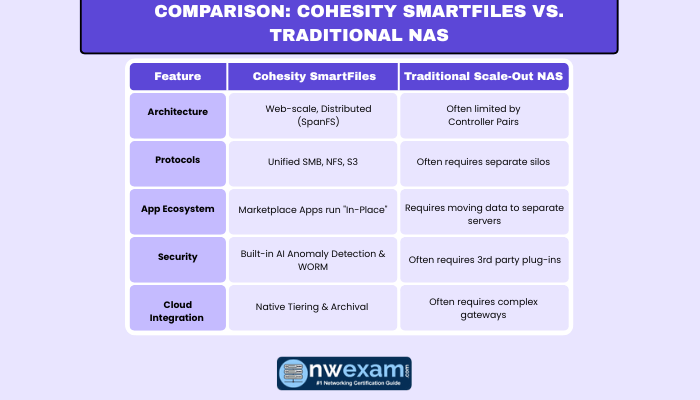
Before diving into the exam specifics, you must grasp the terminology that forms the backbone of the platform. At its heart is SpanFS, Cohesity’s patented, web-scale distributed file system. Unlike traditional NAS, SmartFiles is "data-centric," meaning it integrates applications directly onto the platform to eliminate the need for moving data to apps.
Key terms you will encounter include:
-
Cohesity Views: These are the presentation layers (shares/exports) for NFS, SMB, and S3 protocols.
-
Storage Domains: The logical grouping of nodes that define how data is stored, including deduplication and encryption settings.
-
DataLock: Cohesity's WORM (Write Once, Read Many) capability that ensures data immutability a critical defense against ransomware.
What is the Cohesity COH125 Exam Structure?
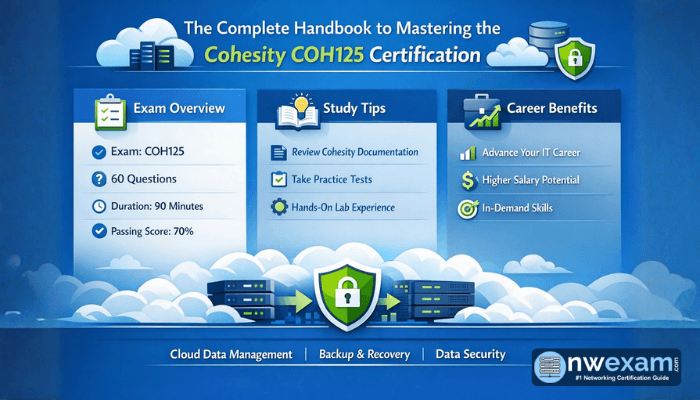
The Cohesity Implementation Professional - SmartFiles (COH125) exam is designed for technical roles like storage administrators and systems engineers. It’s a rigorous test of both theoretical knowledge and practical implementation steps.
-
Exam Price: The Cohesity COH125 certification exam costs $200 USD, making it an affordable investment for professionals aiming to validate their expertise in Cohesity data protection and management solutions.
-
Duration: Candidates are given 90 minutes to carefully read, analyze, and answer all questions, requiring effective time management and focused problem-solving skills.
-
Number of Questions: The exam consists of 70 questions designed to comprehensively assess both theoretical understanding and practical knowledge of Cohesity technologies.
-
Passing Score: To successfully clear the exam, candidates must achieve a minimum score of 60%, demonstrating a solid grasp of the core concepts and skills tested.
To prepare effectively, candidates should review the official exam syllabus and practice with sample questions to get a feel for the question logic.
Breaking Down the Exam Objectives
The exam is divided into five core domains. Understanding the weightage of each helps you prioritize your study time:
-
SmartFiles Administration Concepts (28.33%): This is the largest section. Focus on creating Views, managing quotas, and configuring QoS policies.
-
Security and Compliance (20%): You must know how to enable file service audit logs, configure antivirus, and manage granular permissions.
-
Disaster Recovery Concepts (18.33%): Focus on replication workflows and how to recover data across different Cohesity clusters.
-
Marketplace Application Integration (16.67%): Understand how to run apps like ClamAV or CyberSearch directly on the Cohesity platform.
-
NAS Migration and Tiering (16.67%): This covers moving data from legacy systems (NetApp, Isilon) to Cohesity using the "External NAS Tiering" feature.
Mastering NAS Migration and Data Tiering
One of the most valuable features of SmartFiles is its ability to "clean up" expensive Tier 1 NAS storage. In the Cohesity COH125 exam, you’ll be tested on your ability to move data without disrupting end-users.
Cohesity uses a "Movers" and "Symlinks" approach. When you tier data from a legacy NAS to a Cohesity View, a symbolic link remains on the original source. This ensures that users can still access their files without knowing the data has actually moved to a more cost-effective Cohesity tier.
As noted in the Cohesity SmartFiles official guide, "Automated policy-based management allows for transparent offloading of cold data, drastically reducing TCO."
Steps to a Successful Migration:
-
Discovery: Analyze the existing NAS environment for "cold" data.
-
Configuration: Create a target Cohesity View with matching protocols.
-
Tiering Job: Run the external NAS tiering job to move the data while leaving symlinks.
Security First: Protecting the Data Estate
In 2026, the threat of AI-driven ransomware is higher than ever. Cohesity has responded by making security a pillar of the Cohesity Implementation Professional - SmartFiles curriculum.
The exam expects you to know how to implement a Zero Trust architecture. This includes:
-
Multi-Factor Authentication (MFA): Protecting the Cohesity UI.
-
Role-Based Access Control (RBAC): Ensuring the "Principle of Least Privilege."
-
Encryption: Knowing when to use hardware vs. software-based encryption on Storage Domains.
How to Pass the COH125: A Step-by-Step Action Plan
Preparing for the Cohesity COH125 requires a blend of hands-on experience and strategic study.
-
Get Hands-on. Use the Cohesity Virtual Edition (VE) to practice creating Views and setting up Replication.
-
Master the PDF. Read the official Implementation Professional PDF cover to cover.
-
Use Quality Practice Tests. Visit NWExam.com for updated questions that reflect the 2026 exam environment.
-
Focus on the "Whys." Don't just memorize; understand why you would choose one QoS policy over another.
-
Review the FAQs. Many exam questions mirror common administrative "how-to" scenarios.
FAQs
1. What is the primary use case for Cohesity SmartFiles?
- Cohesity SmartFiles is primarily used for consolidating unstructured data silos, such as digital archives, media libraries, and backup data, into a single, scalable, and secure platform.
2. Can I use Cohesity SmartFiles for S3 object storage?
- Yes, SmartFiles supports the S3 protocol natively, allowing you to access the same data via NFS, SMB, or S3 simultaneously.
3. Should I take the COH125 certification if I am already a backup admin?
- Absolutely. While Cohesity is known for backup (DataProtect), SmartFiles is its fastest-growing segment. Having this certification makes you a more versatile "Data Management" professional.
4. How long is the COH125 certification valid?
- Like most Cohesity certifications, the COH125 is generally valid for two years, after which you may need to recertify to stay updated with the latest platform features.
5. What is the passing score for the Cohesity Implementation Professional exam?
- You need a score of at least 60% to pass the 70-question exam.
6. Where can I find the best Cohesity Implementation Professional SmartFiles PDF?
- The most authoritative source is the Cohesity Academy portal, though study guides on NWExam provide excellent condensed versions for quick review.
Final Thoughts: The Path to Authority
Earning your Cohesity COH125 isn't just about passing a test; it’s about proving you can manage the "lifeblood" of a modern enterprise: its data. By mastering SmartFiles, you position yourself at the intersection of storage, security, and cloud agility.
Ready to begin? Start by reviewing the sample questions on NWExam and commit to a study schedule that targets the administration and security domains. Your future as a Cohesity Certified Implementation Professional starts today!
- COH125 Implementation Professional - SmartFiles |
- COH125 |
- Implementation Professional - SmartFiles Certification Mock Test |
- Implementation Professional - SmartFiles Mock Exam |
- Cohesity Implementation Professional - SmartFiles Primer |
- Implementation Professional - SmartFiles Simulator |
- Implementation Professional - SmartFiles |
- Cohesity Implementation Professional - SmartFiles Practice Test |
- COH125 Syllabus |
- Implementation Professional - SmartFiles Books |
- Implementation Professional - SmartFiles Certification Cost |
- Implementation Professional - SmartFiles Certification Syllabus |
- Cohesity Implementation Professional - SmartFiles Training |
- Cohesity COH125 Books |
- Cohesity Implementation Professional - SmartFiles Books |
- Implementation Professional - SmartFiles Sample Questions |
- Cohesity COH125 Practice Test Free |
- Implementation Professional - SmartFiles Certification Questions and Answers |
- Implementation Professional - SmartFiles Certification Sample Questions


