
The 5 Most Costly H3C GB0-901 Exam Mistakes

The H3C Engineering Project Management (GB0-901 H3CNE-PM) certification is designed for professionals aiming to demonstrate their expertise in managing H3C networking projects effectively. This credential validates a candidate's understanding of industry project management best practices, H3C's proprietary project management processes, overseas business basics, and technical specifications, culminating in real-world case study application. For individuals seeking to lead complex H3C engineering initiatives, mastering these domains is crucial. This article outlines five of the most common and costly mistakes candidates make when approaching the official H3C certification page, offering strategic guidance to avoid these pitfalls and enhance your preparation for the H3C GB0-901 exam.
Understanding the H3C GB0-901 Exam Framework
Before delving into potential missteps, it's vital to have a clear grasp of the H3C GB0-901 H3CNE-PM examination structure. This assessment tests a candidate's practical knowledge and application skills required for successful project execution within the H3C ecosystem. A thorough understanding of the exam's mechanics sets the foundation for an effective study plan and minimizes surprises on exam day.
Exam Structure and Scoring
The H3C Engineering Project Management exam, designated by the code GB0-901 H3CNE-PM, is a critical step for project managers and engineers. Understanding the parameters of the test is the first line of defense against common errors.
-
Exam Name: H3C Engineering Project Management
-
Exam Code: GB0-901 H3CNE-PM
-
Duration: 60 minutes
-
Number of Questions: 50
-
Passing Score: 600 / 1000
-
Exam Price: $168 USD
These details highlight the need for efficient time management and a solid understanding of the material to navigate 50 questions within an hour, aiming for a substantial passing score.
Exploring the H3C GB0-901 Syllabus Domains
The content covered by the H3C GB0-901 exam is comprehensive, spanning various facets of project management specific to the H3C environment. Each topic demands focused attention and a clear strategy to ensure mastery. Candidates often make the mistake of underestimating the depth required for each area.
The syllabus topics include:
-
Industry project management: This foundational area covers general project management principles, methodologies, and lifecycle stages applicable across various industries.
-
H3C project management high-level process: Candidates must understand the overarching framework and key phases of H3C's internal project management approach.
-
H3C overseas business basics: Knowledge of international business operations, cultural nuances, and logistical considerations specific to H3C's global presence is assessed.
-
Low-level process of H3C project management: This delves into the specific steps, procedures, and documentation involved in managing H3C projects on a granular level.
-
H3C engineering technical specification: Understanding the technical standards, product specifications, and quality requirements for H3C engineering solutions is crucial.
-
H3C case study: The ability to apply theoretical knowledge to practical scenarios and troubleshoot real-world H3C project challenges is a key component.
Each of these areas forms a distinct knowledge block, and neglecting any one could prove detrimental to your overall score.
Overlooking Foundational Project Management Principles
A prevalent mistake among H3C GB0-901 candidates is to jump directly into H3C-specific processes without first solidifying their understanding of core industry project management concepts. The syllabus explicitly includes "Industry project management," indicating its fundamental importance. Without a strong grasp of general project lifecycle, stakeholder management, risk assessment, and quality control, the H3C-specific methodologies may seem abstract or lack context.
Impact of a Weak Foundation
Many candidates assume their existing project management experience or other certifications are sufficient for this foundational domain. However, the H3C GB0-901 exam may present questions that test nuanced aspects of industry standards. Failing to review these basics can lead to misinterpretations of H3C's tailored processes.
-
Misinterpreting H3C Context: Without a general PM framework, H3C's specific high-level and low-level processes might be misunderstood, leading to incorrect answers.
-
Inadequate Risk Identification: Core risk management principles are universal. Overlooking them can result in an inability to properly identify and mitigate risks within H3C project scenarios.
-
Ineffective Stakeholder Engagement: Understanding universal stakeholder engagement techniques is essential before applying them to H3C's specific project environments.
Invest time in revisiting the bedrock principles of project management, as they provide the essential lens through which H3C's unique approaches are best understood.
Neglecting H3C-Specific Process Understanding
While general project management knowledge is crucial, an equally costly mistake is underestimating the depth required for H3C's unique project management processes. The syllabus differentiates between "H3C project management high-level process" and "Low-level process of H3C project management," signifying that candidates must comprehend both the strategic overview and the detailed operational steps. Many candidates make the error of studying only one level or treating both as interchangeable.
Distinguishing High-Level from Low-Level Processes
The high-level processes provide the strategic roadmap the "what" and "why" of H3C project phases. This includes understanding the major milestones, decision points, and overall flow. The low-level processes, conversely, detail the "how" the specific tasks, forms, tools, and responsibilities at each stage.
For example, a high-level process might involve a "Project Planning" phase, while the low-level process would describe the exact steps for creating a Work Breakdown Structure (WBS), conducting a resource allocation meeting, or drafting a project charter within H3C's specific operational guidelines.
Ignoring this distinction means you might understand the theory but fail at the practical application, or vice versa. The H3C GB0-901 exam will test both, often through scenarios that require you to apply precise H3C procedures. Reviewing resources like H3C GB0-901 sample questions can highlight this nuance.
Consequences of Insufficient Detail
Failing to grasp the granular details of H3C's low-level processes can lead to significant problems during the exam. Questions often revolve around specific procedures or the correct order of operations that are unique to H3C.
-
Incorrect Operational Steps: Missing knowledge of specific H3C tools, templates, or approval workflows can result in selecting an incorrect action in a scenario-based question.
-
Compliance Failures: H3C's processes are designed for internal compliance and efficiency. A lack of detailed understanding means an inability to ensure projects adhere to these internal standards.
-
Ineffective Problem Solving: In real-world H3C projects, problems often arise from deviations from established low-level processes. The exam may test your ability to identify and rectify such issues using H3C's prescribed methods.
Dedicate ample study time to mapping out H3C's project lifecycle, from strategic intent down to the execution of individual tasks and required documentation.
Underestimating H3C Overseas Business Context
Another critical area where candidates frequently stumble is "H3C overseas business basics." Many project managers are accustomed to domestic operations and may not give sufficient attention to the complexities introduced by international projects. The H3C GB0-901 exam includes this topic because H3C, as a global technology provider, frequently engages in international deployments and partnerships.
Navigating Global Project Challenges
Understanding overseas business essentials goes beyond mere geography; it encompasses legal, cultural, economic, and logistical factors unique to operating across different national borders.
Candidates often overlook:
-
Cultural Sensitivities: Communication styles, negotiation tactics, and team dynamics vary significantly by region. Misunderstanding these can lead to project delays or failures.
-
Regulatory Compliance: Different countries have distinct laws governing data privacy, intellectual property, import/export, and labor practices. H3C project managers must be aware of these.
-
Logistical Complexities: Managing supply chains, equipment delivery, and on-site support across international boundaries introduces unique challenges.
-
Currency and Economic Factors: Exchange rate fluctuations, local taxation, and economic stability can impact project budgets and timelines.
The exam may present scenarios where project success hinges on correctly applying knowledge of these international factors. Merely having technical project management skills is insufficient without this crucial contextual awareness. Prepare by studying case examples of international project deployment and potential global business hurdles.
Disregarding Technical Specifications and Best Practices
The "H3C engineering technical specification" syllabus item is often a source of error for candidates who either lack a strong engineering background or assume a high-level understanding is enough. The H3C GB0-901 certification is for Engineering Project Management, implying a necessary technical depth. Overlooking or skimming this topic can lead to significant gaps in applying project management principles within a technically specific context.
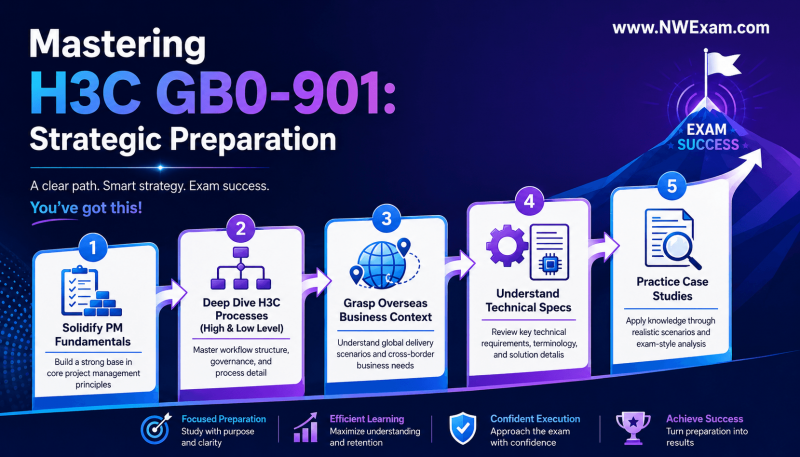
Interpreting Engineering Requirements Accurately
Project managers in H3C engineering roles must not only understand *how* to manage a project but also *what* they are managing from a technical standpoint. This involves being able to read, interpret, and ensure compliance with H3C's specific technical standards.
-
Product Specifications: Understanding the performance, functionality, and integration requirements of H3C products and solutions.
-
Deployment Standards: Knowledge of best practices for installation, configuration, and commissioning H3C equipment, including network design principles.
-
Quality Assurance Protocols: Familiarity with testing procedures, acceptance criteria, and quality control measures specific to H3C engineering projects.
-
Troubleshooting Fundamentals: While not a deep technical exam, project managers should have enough technical insight to understand potential issues and guide their resolution.
Mistakes here often manifest as an inability to identify technical non-compliance in a scenario or prioritize technical tasks correctly. Success requires connecting project management steps directly to the underlying technical realities of H3C solutions. Explore H3C training and certification resources to deepen this technical understanding.
Failing to Analyze Real-World H3C Case Studies
The final and perhaps most overlooked mistake is neglecting the "H3C case study" component of the syllabus. Many candidates focus heavily on theoretical knowledge or process memorization but fail to practice applying this knowledge to complex, integrated scenarios. The case study section is designed to test your ability to synthesize information from all other domains and make sound project management decisions under realistic constraints.
Applying Knowledge in Practical Scenarios
Case studies on the H3C GB0-901 exam are not simply multiple-choice questions about isolated topics. They are likely intricate scenarios that combine elements of industry project management, H3C's high and low-level processes, overseas business challenges, and technical specifications.
Common pitfalls in this area include:
-
Disjointed Application: Applying principles in isolation rather than integrating them to solve a multifaceted problem.
-
Lack of Critical Thinking: Failing to analyze the hidden risks, implicit stakeholder needs, or long-term implications presented in a case.
-
Poor Decision Prioritization: In complex scenarios, multiple issues may arise. The ability to prioritize and address the most critical problems using H3C methodologies is key.
Effective preparation for case studies involves more than just reading; it requires active problem-solving. Practice by deconstructing complex project scenarios, identifying key issues, brainstorming solutions based on the H3C framework, and evaluating potential outcomes. Look for opportunities to apply what you've learned from each syllabus section to integrated, real-world examples. This holistic approach ensures you can navigate the complexities of actual H3C engineering projects and perform well on the exam.
Conclusion
The H3C GB0-901 H3CNE-PM certification is a significant milestone for project managers seeking to validate their expertise in H3C engineering environments. Avoiding the common pitfalls discussed overlooking foundational principles, neglecting H3C-specific process details, underestimating overseas business complexities, disregarding technical specifications, and failing to engage with case studies is paramount to your success. Each mistake represents a gap in either knowledge or application that the exam is designed to expose.
By adopting a comprehensive and integrated study approach, focusing on both theoretical understanding and practical application across all syllabus domains, you can significantly increase your chances of passing the H3C GB0-901 exam. Prioritize thorough preparation, leverage official resources, and practice scenario-based questions to build confidence and readiness. Take the time to understand not just *what* H3C's processes are, but *why* they are structured that way, and *how* they apply in varied real-world contexts. Embark on your certification journey with a clear strategy to master H3C Engineering Project Management.
Ready to solidify your understanding and ensure you don't fall victim to these common mistakes? Explore comprehensive study resources and practice tests designed to help you prepare effectively for the H3C GB0-901 certification. With dedicated preparation, your success is within reach.
Frequently Asked Questions
1. What is H3CNE-PM certification?
The H3CNE-PM certification validates engineering project management skills within H3C networking environments. It focuses on planning, coordination, implementation, and delivery management.
2. How difficult is the H3C GB0-901 exam?
The exam is moderately difficult for candidates without project management experience. Scenario-based preparation and mock testing significantly improve success rates.
3. What are the best resources for H3C GB0-901 exam preparation?
The best resources include official H3C documentation, structured practice exams, scenario-based questions, and detailed exam blueprints from trusted platforms.
4. How long should I study for the H3C GB0-901 certification exam?
Most candidates prepare for 6–8 weeks with consistent daily study sessions and weekly mock tests.
5. Are H3C GB0-901 sample questions useful?
Yes. Quality sample questions improve familiarity with exam patterns, strengthen time management, and reveal weak areas.
6. What career opportunities come after H3CNE-PM certification?
Professionals may pursue roles such as Network Project Engineer, Technical Project Manager, Infrastructure Coordinator, and Enterprise Deployment Specialist.
7. Does the H3C GB0-901 exam include project management concepts?
Yes. Project lifecycle management, communication planning, risk control, and engineering coordination are major parts of the exam.
8. Is H3C GB0-901 certification worth it?
Yes. The certification strengthens professional credibility, improves career prospects, and validates engineering project management expertise.
- GB0-901 |
- Engineering Project Management Certification Mock Test |
- Engineering Project Management Mock Exam |
- Engineering Project Management Practice Test |
- H3C Engineering Project Management Primer |
- Engineering Project Management Simulator |
- Engineering Project Management |
- H3CNE-PM Exam Questions |
- H3C H3CNE-PM Questions |
- H3C Engineering Project Management |
- H3C H3CNE-PM Practice Test |
- H3C Certified Network Engineer for Project Management (H3CNE-PM) |
- GB0-901 Syllabus |
- Engineering Project Management Books |
- Engineering Project Management Certification Cost |
- Engineering Project Management Certification Syllabus |
- H3C Engineering Project Management Training |
- H3C GB0-901 Books |
- H3C H3CNE-PM Books |
- Engineering Project Management Sample Questions |
- H3C GB0-901 Practice Test Free |
- H3CNE-PM Certification Questions and Answers |
- H3CNE-PM Certification Sample Questions


