
7 Critical Mistakes to Avoid for Cisco 300-830 CLCCE Exam Success
Navigating the landscape of modern customer experience requires more than just a basic understanding of hardware; it demands a sophisticated grasp of cloud-based interactions. The 300-830 CLCCE exam, or "Implementing Cisco Collaboration Cloud Customer Experience," is the benchmark for professionals aiming to prove their expertise in the Webex ecosystem. From orchestrating complex telephony and call routing to deploying cutting-edge AI features, this 90-minute assessment validates your ability to manage the future of digital engagement. Achieving this certification isn't just about passing a test; it’s about mastering the ecosystem that connects brands to their customers. Whether you are configuring multi-channel flows or deploying AI chatbots, the 300-830 CLCCE validates your ability to deliver seamless, high-performance collaboration solutions.
However, the path to becoming a certified specialist is fraught with technical hurdles. Many candidates approach the 300-830 CLCCE with a legacy mindset, failing to account for the nuances of cloud-native tenant configurations and the rapid evolution of digital channels. To help you cross the finish line, we’ve identified the seven most common mistakes that can derail your certification journey.
7 Critical Mistakes to Avoid for Cisco 300-830 CLCCE Exam Success
1. Underestimating the Weight of Telephony and Call Routing
A significant 30% of the exam focuses on Telephony and Call Routing. Many students assume their knowledge of on-premises Unified Communications will carry them through. In the Webex Contact Center environment, routing logic operates differently. You must understand entry points, queues, and how global routing strategies impact the end-user experience.
Failing to grasp the flow of a call from the PSTN through the Webex cloud often results in lost marks. Ensure you can visualize the signaling path and identify where a "bottleneck" might occur in a hybrid deployment.
2. Treating Digital Channels as an "Afterthought"
With a 15% weightage, Digital Channels might seem small, but they are often the difference between a pass and a fail. Modern customer experience isn't just about voice; it’s about email, chat, and social messaging.
If you aren't comfortable configuring how a Webex tenant handles an incoming chat versus a standard voice call, you are at risk. The exam tests your ability to integrate these streams into a cohesive omni-channel strategy.
3. Neglecting Tenant Configuration and Reporting Nuances
Another 30% of your score comes from Tenant Configuration and Reporting. This isn't just about ticking boxes in a dashboard. You need to understand how to pull meaningful data to drive business decisions.
Common mistakes include:
-
Confusing "Real-Time" reporting with "Historical" reporting capabilities.
-
Misunderstanding user profiles and role-based access controls (RBAC) within the tenant.
-
Ignoring the importance of Threshold Alerts in supervisor dashboards.
4. Overlooking the Impact of AI and Advanced Features
The Cisco 300-830 syllabus allocates 25% to Advanced Features and AI. In 2026, AI is no longer a "bonus" feature it is core to the Cisco strategy. Candidates often fail because they don't understand how Webex utilizes AI for agent assistance, transcriptions, and sentiment analysis.
You must be able to explain how the Webex App Hub integrates with these AI capabilities to automate routine tasks.
5. Relying Solely on Theory Without Practice
Cisco exams are notorious for testing "scenario-based" knowledge. You can memorize the official Cisco CLCCE exam topics, but if you haven't touched the interface, the questions will feel foreign. Use Cisco 300-830 practice tests to simulate the pressure of the 90-minute window.
6. Ignoring the Relationship Between Webex and the Broader CCNP Collaboration
The 300-830 CLCCE is a concentration exam for the CCNP Collaboration. A mistake often made is studying it in a vacuum. Understanding how it interacts with Cisco Unified Communications Manager (CUCM) or Cisco IOS XE gateways is vital for "Telephony and Call Routing" questions.
7. Failing to Prepare for the Cisco 300-830 CLCCE Exam Format
The 90-minute limit is tight. Many candidates spend too long on a single complex routing question and run out of time for the AI and Digital Channel sections. Practicing with a timer is the only way to build the "exam stamina" required.
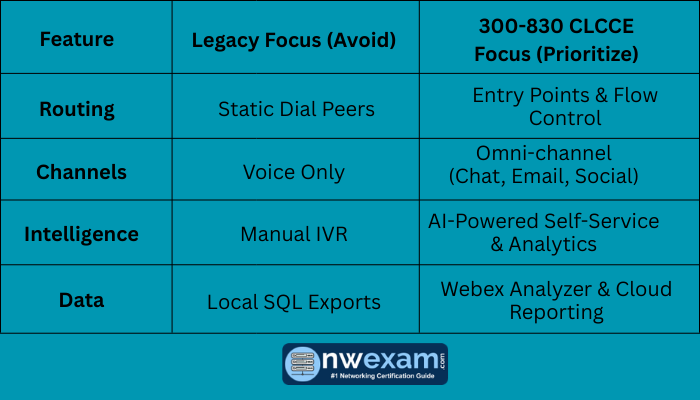
Comparison: Legacy vs. Modern Cloud Contact Center Focus
Step-by-Step: Your Path to 300-830 Success
-
Review the Blueprint: Download the official Cisco 300-830 CLCCE PDF.
-
Lab It Up: Access a Webex Contact Center sandbox to configure tenants and flows.
-
Benchmark Knowledge: Take 300-830 sample questions to identify weak spots.
-
Master the AI: Study how the Webex App Hub and AI Assistant enhance agent productivity.
-
Final Polish: Focus on reporting syntax and digital channel integration 48 hours before the test.
What are the Benefits of Passing the CCNP Collaboration 300-830 CLCCE Exam?
Passing this exam doesn't just grant a badge; it proves you can lead a digital transformation. Organizations are migrating to the cloud at record speeds, and they need engineers who can bridge the gap between traditional telephony and modern AI-driven customer experiences. By mastering the Cisco CLCCE, you position yourself as a high-value asset in the CCNP Collaboration ecosystem.
FAQs
1. What is the 300-830 CLCCE exam?
- The 300-830 CLCCE exam is a Cisco certification test focusing on Webex Contact Center, routing, AI, and digital channels.
2. How difficult is the Cisco 300-830 exam?
- It is moderately difficult, requiring both theoretical knowledge and practical skills.
3. How long should I study for the 300-830 CLCCE exam?
- Most candidates need 6–8 weeks of focused preparation.
4. Are practice tests necessary for CLCCE?
- Yes, practice tests help identify gaps and improve exam readiness.
5. What topics are most important in 300-830 CLCCE?
- Telephony, tenant configuration, and AI features carry the highest weight.
6. Can I pass the CLCCE exam without hands-on experience?
- It is possible but difficult. Practical experience greatly improves success.
Conclusion
Success in the 300-830 CLCCE exam is about more than just avoiding mistakes; it’s about embracing the shift to cloud-first collaboration. By focusing on the 30% weightage of telephony, mastering the AI features, and practicing with realistic Cisco 300-830 practice tests, you can confidently secure your certification. Don't let these seven common pitfalls hold you back from becoming a leader in the Cisco Collaboration space.
Would you like me to create a customized study schedule for your 300-830 CLCCE preparation?
- CCNP Collaboration Certification Mock Test |
- Cisco CCNP Collaboration Certification |
- CCNP Collaboration Mock Exam |
- CCNP Collaboration Practice Test |
- Cisco CCNP Collaboration Primer |
- CCNP Collaboration Question Bank |
- CCNP Collaboration Simulator |
- CCNP Collaboration Books |
- CCNP Collaboration Certification Cost |
- CCNP Collaboration Certification Syllabus |
- 300-830 CCNP Collaboration |
- 300-830 |
- CLCCE Exam Questions |
- Cisco CLCCE Questions |
- Cisco CLCCE Practice Test |
- Cisco Certified Specialist - Collaboration Cloud Customer Experience |
- 300-830 Syllabus |
- Cisco 300-830 Books |
- Cisco CLCCE Books |
- Cisco 300-830 Practice Test Free |
- CLCCE Certification Questions and Answers |
- CLCCE Certification Sample Questions


