
One Critical FortiNDR Cloud Analyst Certification Mistake You're Likely Making
The Fortinet NSE 6 - FortiNDR Cloud 26 Analyst certification, identified by exam code NSE6_NDR_AN-26, validates a candidate's ability to effectively use FortiNDR Cloud for advanced network detection and response tasks. This credential is designed for security analysts, incident responders, and network security professionals who manage and monitor network threats using Fortinet's cloud-based Network Detection and Response solution. It signifies a professional’s proficiency in identifying, analyzing, and mitigating sophisticated cyber threats, ensuring robust network security posture. This article delves into a crucial mistake many candidates make while pursuing FortiNDR Cloud Analyst Certification, offering guidance on how to avoid it and secure your path to success.
Understanding the FortiNDR Cloud Analyst Exam Framework
Aspiring FortiNDR Cloud Analysts must first grasp the foundational structure of the NSE6_NDR_AN-26 exam to avoid missteps in their preparation. This understanding goes beyond simply knowing the topics; it involves appreciating the exam's design to test practical application, not just rote memorization. The Fortinet NSE 6 - FortiNDR Cloud 26 Analyst exam is a crucial step for professionals aiming to demonstrate their expertise in deploying, managing, and troubleshooting FortiNDR Cloud. It's an assessment designed to ensure candidates possess the real-world skills needed in today's demanding cybersecurity landscape.
The official details for the Fortinet NSE6_NDR_AN-26 certification exam are as follows:
-
Exam Name: Fortinet NSE 6 - FortiNDR Cloud 26 Analyst
-
Exam Code: NSE6_NDR_AN-26 FortiNDR Cloud Analyst
-
Duration: 65–75 minutes
-
Number of Questions: 30-40 questions
-
Passing Score: Pass / Fail
-
Exam Price: $200 USD
These parameters highlight a fast-paced exam environment where quick, accurate decision-making is essential. Candidates cannot afford to dwell on a single question, nor can they rely on shallow knowledge. A comprehensive strategy that accounts for both depth of understanding and efficient recall is paramount.
Deconstructing the NSE6_NDR_AN-26 Syllabus Topics
A thorough review of the exam syllabus is the cornerstone of any effective preparation strategy for the FortiNDR Cloud Analyst Certification. The syllabus outlines the specific domains and their respective weightages, providing a clear roadmap of what to study. However, simply skimming these topics is a common pitfall; the real value lies in deconstructing each area to understand its practical implications and Fortinet’s expected competency level. This analytical approach helps candidates prioritize their study efforts and identify potential weaknesses before the exam. For further comprehensive preparation, exploring additional FortiNDR Cloud practice questions can be invaluable.
The NSE6_NDR_AN-26 exam covers the following key areas:
-
Architecture and system settings (15–25%): This section assesses your understanding of FortiNDR Cloud's core components, deployment models, and initial configuration. It includes topics like tenant management, data sources, and system-wide configurations that dictate how FortiNDR Cloud operates within an organization's security infrastructure. A deep understanding here is fundamental to leveraging the platform effectively.
-
Events and queries (25–35%): The largest weighted section, this area focuses on your ability to navigate, interpret, and query event data generated by FortiNDR Cloud. It covers event types, logging mechanisms, and the powerful search capabilities required to pinpoint security incidents. Proficiency in crafting complex queries and understanding event correlation is critical for success.
-
Detection (15–25%): This domain evaluates your knowledge of FortiNDR Cloud's detection mechanisms, including threat intelligence integration, machine learning capabilities, and customizable detection rules. It delves into how the platform identifies suspicious activities, anomalies, and known threats within network traffic and endpoints. Candidates should be familiar with various detection engines and their tuning.
-
Investigations and integrations (20–30%): This section measures your aptitude for conducting incident investigations using FortiNDR Cloud's tools and integrating it with other security solutions. Topics include incident management workflows, evidence collection, reporting, and how FortiNDR Cloud interacts with Security Information and Event Management (SIEM) systems or Security Orchestration, Automation, and Response (SOAR) platforms.
Each percentage range indicates the relative importance of the topic area, guiding candidates to allocate their study time wisely. Neglecting any of these domains, especially the higher-weighted ones, can significantly jeopardize exam performance.
The Hidden Pitfall: Overlooking Practical Scenario Application
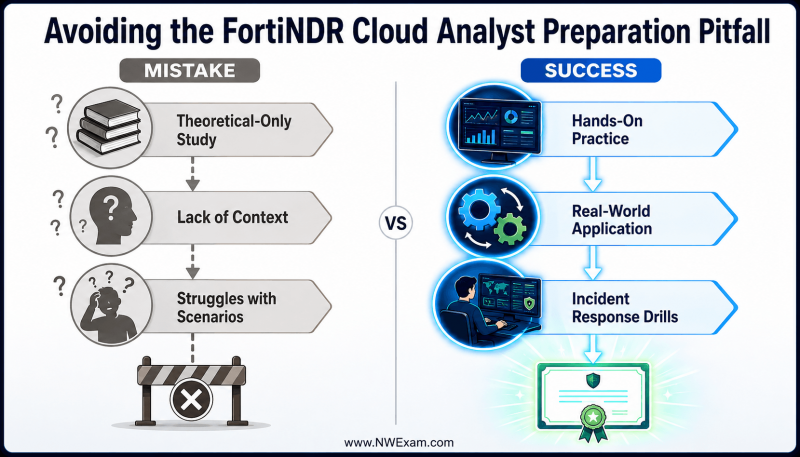
The single most critical mistake candidates make when preparing for the FortiNDR Cloud Analyst Certification is focusing too heavily on theoretical knowledge without adequately applying it to practical, real-world scenarios. Many candidates diligently study each syllabus topic, memorize definitions, and understand concepts in isolation. However, the NSE6_NDR_AN-26 exam is designed to test an analyst's ability to *use* FortiNDR Cloud, not just describe it. This means questions often present a problem statement or a simulated network event, requiring you to apply your knowledge to identify the correct FortiNDR Cloud feature, workflow, or diagnostic step.
Why Theoretical-Only Study Fails
Relying solely on textbooks and abstract concepts creates a significant gap between learned material and the actual demands of the certification exam. Cybersecurity is inherently a hands-on field, and Fortinet certifications, particularly at the NSE 6 level, are structured to validate practical competence. When confronted with a scenario-based question, candidates who have only engaged with theory often struggle to:
-
Identify the appropriate tool: They might know what FortiNDR Cloud does, but not which specific dashboard, query, or report is relevant to a given incident.
-
Interpret context: Real-world scenarios are messy, involving multiple data points that need to be correlated. Theoretical knowledge alone doesn't train the brain to filter noise and focus on critical indicators.
-
Formulate a solution: Simply understanding a concept is different from constructing a step-by-step resolution to a security event using the platform's features.
This disconnect leads to frustration and often a "pass/fail" result that surprises even well-read candidates. The exam doesn't just ask "What is FortiNDR Cloud?"; it asks "Given this alert, what is your next step in FortiNDR Cloud?" The official Fortinet certification page emphasizes the analyst role, which is inherently practical.
The Importance of Hands-On Simulation
To bridge this gap, candidates must immerse themselves in practical application. This means going beyond theoretical understanding and actively engaging with the FortiNDR Cloud platform or realistic simulations. The value of this approach cannot be overstated, as it solidifies theoretical knowledge by showing how concepts manifest in a live environment. For example, understanding what "event correlation" is from a textbook is one thing; actually building and refining event correlation rules in a sandbox FortiNDR Cloud instance is an entirely different, and far more effective, learning experience.
Without direct exposure or high-fidelity simulation, the subtle nuances of FortiNDR Cloud's interface, its reporting capabilities, and the logical flow of its investigation tools remain abstract. The exam questions are crafted to reflect these real-world interactions, making hands-on experience not just beneficial, but essential.
Mastering Real-World FortiNDR Cloud Deployments
To overcome the common mistake of theoretical-only study, the emphasis must shift towards hands-on engagement with FortiNDR Cloud functionalities. This approach ensures that candidates are not just learning facts, but developing the intuitive understanding and problem-solving skills required of a certified analyst. A certified professional is expected to demonstrate competence in live environments, and your preparation should mirror this expectation.
Leveraging Fortinet Training Resources
Fortinet offers various training pathways designed to provide practical experience. While not all resources may be free, investing in official training or lab environments can significantly accelerate your understanding. These resources often include:
-
Virtual Labs: Controlled environments where you can practice configuring, monitoring, and responding to simulated threats using FortiNDR Cloud.
-
Guided Exercises: Step-by-step instructions for performing common analyst tasks, reinforcing theoretical concepts with practical application.
-
Official Courseware: Often includes practical scenarios and case studies that mirror exam questions and real-world challenges.
Engaging with these resources transforms abstract knowledge into actionable skills. It allows you to make mistakes, troubleshoot, and learn from experience in a low-risk environment, which is far more effective than trying to recall information under exam pressure.
Simulating Incident Response Workflows
A significant portion of the FortiNDR Cloud Analyst exam, particularly in the "Investigations and integrations" section, focuses on incident response. This requires more than just knowing what FortiNDR Cloud does; it demands understanding the *process* of using it during an incident. Candidates should practice simulating entire incident response workflows, from initial detection to investigation and mitigation.
Consider these practical exercises:
-
Alert Triage: Practice reviewing incoming alerts, determining their severity, and deciding which require immediate attention.
-
Data Correlation: Work through scenarios where you need to correlate data from multiple sources within FortiNDR Cloud to piece together an attack narrative.
-
Query Building: Practice constructing complex queries to filter events, identify specific indicators of compromise (IoCs), and trace attacker activities.
-
Reporting: Learn to generate clear, concise reports on findings, which is crucial for communicating incident details to stakeholders.
This holistic approach ensures you are prepared for the multi-faceted questions that often combine knowledge from different syllabus domains. Developing a routine that includes these types of practical exercises is invaluable.
Elevating Your Network Security Expertise with FortiNDR Cloud
Achieving the FortiNDR Cloud Analyst Certification signifies a professional's elevated capabilities in modern network defense, moving beyond traditional security approaches to embrace sophisticated detection and response mechanisms. This credential acts as a testament to one's ability to not only identify threats but also to proactively mitigate them using Fortinet's advanced cloud-native solution. It positions certified individuals as key contributors in safeguarding organizational assets against an ever-evolving threat landscape.
Enhancing Threat Visibility and Response
The FortiNDR Cloud Analyst certification directly enhances a professional’s ability to provide superior threat visibility and response. By understanding FortiNDR Cloud's capabilities deeply, an analyst can:
-
Identify Evolving Threats: Use machine learning and behavioral analytics to detect advanced threats. Integrate threat intelligence for better detection. These technologies can help identify zero-day attacks and evasive threats. They can also detect threats that bypass traditional signature-based security solutions.
-
Streamline Investigations: Leverage the platform's advanced querying and data visualization tools to quickly understand the scope and impact of an incident, reducing mean time to detect (MTTD) and mean time to respond (MTTR).
-
Optimize Security Operations: Integrate FortiNDR Cloud with existing security tools, such as FortiGate firewalls or FortiAnalyzer, to create a cohesive and automated security fabric, enhancing overall operational efficiency.
This level of expertise is highly sought after by organizations grappling with increasingly complex cyberattacks. The certification therefore not only validates existing skills but also equips professionals with advanced methodologies critical for future-proofing security postures.
Driving Career Opportunities in Security Operations
For individuals pursuing a career in security operations, incident response, or threat hunting, the FortiNDR Cloud Analyst certification opens doors to advanced roles and responsibilities. The demand for skilled professionals proficient in Network Detection and Response (NDR) solutions is growing rapidly as organizations realize the limitations of prevention-only strategies. Holding this Fortinet NSE 6 certification demonstrates a specialized skill set that distinguishes candidates in a competitive job market. Professionals with this credential are often considered valuable assets capable of leading incident response efforts, refining detection strategies, and contributing to the strategic direction of an organization’s security program. This aligns well with the broader landscape of Fortinet Security Operations certifications, which aims to cultivate expertise across various critical security domains.
Crafting an Effective Study Plan for FortiNDR Cloud Analyst Success
An effective study plan for the FortiNDR Cloud Analyst Certification (NSE6_NDR_AN-26) goes beyond merely reading through materials. It involves a strategic, multi-faceted approach that integrates theoretical learning with crucial practical application, specifically addressing the common pitfall of overlooking hands-on scenarios. This section outlines a structured approach to maximize your chances of success, ensuring comprehensive coverage and deep understanding.
Structured Content Review
Begin your preparation by thoroughly reviewing each syllabus domain. Don't just read; actively engage with the content.
Deep Dive into Architecture and System Settings: Understand the foundational elements. How does FortiNDR Cloud ingest data? What are the key configuration options for different data sources? Focus on the implications of each setting.
-
Master Events and Queries: This is a high-weightage area. Practice constructing complex queries. Understand the different data fields available, and how to filter, group, and summarize event data effectively. Use examples to solidify your query-building skills.
-
Examine Detection Mechanisms: Explore the types of threats FortiNDR Cloud detects and how it does so. Differentiate between signature-based, behavioral, and machine learning detections. Learn how to fine-tune detection rules to minimize false positives and negatives.
-
Understand Investigations and Integrations: Walk through incident response workflows. How would you investigate a specific alert from start to finish using FortiNDR Cloud? What integrations with other security tools are possible, and what benefits do they offer?
For each topic, try to explain it in your own words or teach it to someone else. This active recall method is far more effective than passive reading.
Integrating Practice and Scenario-Based Learning
This is where you directly address the "critical mistake." Allocate significant time to hands-on practice.
-
Utilize Virtual Labs: If available, spend time in Fortinet virtual labs or sandbox environments dedicated to FortiNDR Cloud. Experiment with configurations, generate simulated alerts, and practice investigation techniques.
-
Work Through Case Studies: Find or create your own hypothetical scenarios. For instance, "A new ransomware variant is detected; how would FortiNDR Cloud identify it, and what steps would an analyst take?"
-
Practice Query Challenges: Set yourself tasks like "Find all network connections from an internal host to a known malicious IP address within the last 24 hours" and then build the FortiNDR Cloud query.
-
Review Sample Questions: While not a substitute for hands-on, analyzing sample questions for their scenario-based nature helps you understand the exam's testing style. Focus on why a particular answer is correct and why others are incorrect, especially for questions involving decision-making.
This dual-pronged approach helps you master the facts. It also helps you apply them effectively under pressure. This mirrors the demands of the exam. It also reflects the challenges of working in a real-world security operations center.
Reinforcing Your FortiNDR Cloud Expertise
Beyond initial preparation, continuous reinforcement of your FortiNDR Cloud expertise is vital for maintaining a competitive edge and ensuring long-term success as a security analyst. The cybersecurity landscape is constantly evolving, and a static understanding of any tool or concept quickly becomes outdated. For the FortiNDR Cloud Analyst, this means staying current with product updates, emerging threats, and new best practices.
Engaging with the Fortinet Community
One of the most effective ways to reinforce your knowledge is through active participation in the Fortinet community. This includes official forums, user groups, and webinars. These platforms offer invaluable opportunities to:
-
Learn from Peers: Observe how other experienced analysts troubleshoot problems or leverage FortiNDR Cloud features in unique ways.
-
Share Knowledge: Answering questions or discussing challenges with others helps solidify your own understanding and exposes you to diverse perspectives.
-
Stay Informed: Fortinet product managers and experts often participate in these communities, providing insights into upcoming features, security advisories, and advanced usage tips.
This collective intelligence is a powerful tool for continuous learning and ensures your skills remain sharp and relevant.
Regularly Reviewing Documentation and Updates
FortiNDR Cloud, like any advanced security platform, receives regular updates that introduce new features, enhance existing ones, and patch vulnerabilities. As a certified analyst, it is your responsibility to stay abreast of these changes.
-
Product Release Notes: Periodically review the release notes for FortiNDR Cloud to understand new functionalities. This can often provide practical scenarios for self-practice.
-
Configuration Guides: Revisit official configuration and administration guides, especially for complex features you might not use daily.
-
Threat Intelligence Feeds: Understand how FortiNDR Cloud integrates with threat intelligence and how to interpret new threat data within the platform. This directly correlates with detection capabilities.
Making this a habit ensures that your theoretical and practical knowledge of FortiNDR Cloud is always aligned with the latest version and the most current threat landscape. This proactive approach to learning is a hallmark of truly skilled and impactful security professionals.
Conclusion
The Fortinet NSE 6 - FortiNDR Cloud 26 Analyst certification is a powerful credential that validates critical skills in network detection and response. While thorough theoretical study is important, the single most significant mistake candidates make is neglecting hands-on, scenario-based practice. The exam demands not just knowledge, but the practical application of FortiNDR Cloud's features to real-world security incidents. By integrating official training resources, simulating incident response workflows, and continuously engaging with the Fortinet community, aspiring analysts can bridge this gap and prepare effectively.
Embrace a study strategy that prioritizes practical engagement, ensuring you can confidently navigate FortiNDR Cloud's capabilities under pressure. This approach will not only help you pass the NSE6_NDR_AN-26 exam but also equip you with the tangible skills needed to excel in a demanding cybersecurity role. To further enhance your exam readiness and practice problem-solving, consider utilizing comprehensive Fortinet NSE 6 sample questions that simulate the real exam environment.
Frequently Asked Questions
1. What skills does the FortiNDR Cloud Analyst certification validate?
The FortiNDR Cloud Analyst certification validates a professional's expertise in deploying, configuring, monitoring, and investigating security incidents using Fortinet's FortiNDR Cloud solution. It confirms proficiency in areas like architecture, event analysis, threat detection, and integration with other security tools.
2. Who should consider taking the NSE6_NDR_AN-26 exam?
This exam is ideal for security analysts, incident responders, network security engineers, and other cybersecurity professionals who are responsible for detecting, analyzing, and responding to advanced threats using FortiNDR Cloud in their daily roles.
3. How important is hands-on experience for this certification?
Hands-on experience is critically important. The exam is highly scenario-based, requiring candidates to apply their theoretical knowledge to practical situations within the FortiNDR Cloud platform. Purely theoretical study is often insufficient for success.
4. Are there any prerequisites for the FortiNDR Cloud Analyst certification?
While Fortinet generally recommends foundational knowledge in networking and security, specific formal prerequisites for the NSE6_NDR_AN-26 exam may vary. It's always best to check the official Fortinet training website for the most current information and recommended preparation paths.
5. What career benefits can I expect after achieving this certification?
Achieving this certification can open doors to advanced roles in security operations, incident response, and threat hunting. It demonstrates specialized skills in a high-demand area of cybersecurity. This can lead to more job opportunities and career growth. It may also increase your earning potential. These benefits can extend across the Fortinet ecosystem and beyond.
- NSE6_NDR_AN-26 FortiNDR Cloud Analyst |
- NSE6_NDR_AN-26 |
- FortiNDR Cloud Analyst Certification Mock Test |
- FortiNDR Cloud Analyst Mock Exam |
- FortiNDR Cloud Analyst Practice Test |
- Fortinet FortiNDR Cloud Analyst Primer |
- FortiNDR Cloud Analyst Simulator |
- FortiNDR Cloud Analyst Exam Questions |
- Fortinet FortiNDR Cloud Analyst Questions |
- Fortinet NSE 6 - FortiNDR Cloud Analyst |
- Fortinet FortiNDR Cloud Analyst Practice Test |
- NSE6_NDR_AN-26 Syllabus |
- FortiNDR Cloud Analyst Certification Cost |
- FortiNDR Cloud Analyst Certification Syllabus |
- Fortinet FortiNDR Cloud Analyst Training |
- Fortinet NSE6_NDR_AN-26 Books |
- Fortinet FortiNDR Cloud Analyst Books |
- FortiNDR Cloud Analyst Sample Questions |
- Fortinet NSE6_NDR_AN-26 Practice Test Free |
- FortiNDR Cloud Analyst Certification Questions and Answers |
- FortiNDR Cloud Analyst Certification Sample Questions


