
What XSOAR Engineer Gurus Know (You Don't Yet)

The Palo Alto Networks XSOAR Engineer certification is a critical credential for cybersecurity professionals aiming to master security orchestration, automation, and response (SOAR) principles. This certification validates an individual’s ability to deploy, manage, and optimize the Palo Alto Networks XSOAR platform, transforming reactive security operations into proactive, automated defenses. Aimed at security analysts, incident responders, and automation specialists, this advanced guide provides an in-depth exploration of the skills and knowledge required to achieve expert-level proficiency and successfully navigate the XSOAR-Engineer exam, ultimately enhancing an organization's security posture through efficient automation.
Commanding the Palo Alto Networks XSOAR Engineer Mandate
A Palo Alto Networks XSOAR Engineer shoulders the vital responsibility of designing, implementing, and maintaining automated security workflows that significantly reduce response times and manual effort. This role is fundamental in today's fast-evolving threat landscape, where speed and precision in incident response are paramount. Professionals in this domain are not merely configuring tools; they are architecting the future of security operations, building resilient and adaptive systems to combat sophisticated cyber threats.
Core Competencies for XSOAR Automation
At the heart of an XSOAR Engineer's expertise lies a robust understanding of scripting, API integrations, and security processes. These professionals must translate complex security playbooks into executable code within the XSOAR platform. Their daily tasks often involve working with various security tools, correlating data, and orchestrating responses across disparate systems to create a unified defensive front.
Developing effective automation requires a deep dive into the specifics of an organization's IT environment and security requirements. It demands the ability to analyze current security operations, identify bottlenecks, and then craft tailored automation solutions that align with strategic objectives. This involves not only technical skill but also a keen analytical mindset to foresee potential issues and design resilient playbooks.
Implementing Security Orchestration Playbooks
Effective playbook implementation is a cornerstone of the XSOAR Engineer role. This involves converting incident response procedures, threat intelligence enrichment, and vulnerability management tasks into automated workflows. These playbooks are dynamic, capable of adapting to new threats and evolving organizational needs, ensuring continuous and optimized security operations. The engineer must be adept at debugging, testing, and refining these automated processes to ensure their accuracy and efficiency.
Moreover, the engineer is responsible for integrating XSOAR with existing security tools, such as SIEMs, firewalls, endpoint detection and response (EDR) solutions, and threat intelligence platforms. Seamless integration ensures that data flows correctly between systems, enabling XSOAR to gather necessary context, execute commands, and update records automatically, minimizing human intervention and accelerating incident resolution.
Why Pursue XSOAR Engineer Certification?
Achieving the Palo Alto Networks XSOAR Engineer certification signifies a professional's deep practical knowledge and strategic understanding of the XSOAR platform. This credential extends beyond mere validation; it serves as a differentiator in a competitive cybersecurity market, demonstrating a commitment to advanced automation techniques and effective security operations. It signals to employers that an individual possesses the specialized skills to leverage SOAR technologies for tangible business benefits.
Elevating Career Trajectories with XSOAR Mastery
The demand for SOAR expertise is rapidly escalating as organizations strive to enhance their defensive capabilities and streamline security operations. Holding an essential XSOAR Engineer certification can unlock advanced career opportunities, leading to roles such as SOAR Specialist, Automation Engineer, or Senior Security Analyst. These positions command higher salaries and greater influence within security teams, allowing certified professionals to lead initiatives that redefine how security is managed and executed.
Furthermore, this certification equips individuals with a transferable skill set applicable across various industries and organizational sizes. The principles of orchestration and automation are universal in modern cybersecurity, making XSOAR-certified professionals highly valuable assets in any environment focused on operational efficiency and robust threat response.
Validating Expertise in Security Orchestration and Automation
The certification process itself is a rigorous validation of an individual's hands-on proficiency with the XSOAR platform. It confirms an understanding of best practices for SOAR implementation, including playbook design, integration strategies, and system maintenance. This level of verified expertise assures organizations that their critical security automation initiatives are in capable hands, reducing operational risk and maximizing their investment in SOAR technology. The comprehensive assessment covers not just theoretical knowledge but practical application scenarios, mirroring real-world challenges.
Key Areas of XSOAR Platform Automation
Mastering the Palo Alto Networks XSOAR platform requires proficiency across several critical domains, each contributing to a holistic understanding of security automation. From incident response to custom content development, the XSOAR Engineer must be adept at leveraging the platform's full capabilities to create a truly automated and orchestrated security environment. This advanced insight into the platform enables engineers to anticipate challenges and innovate solutions, pushing the boundaries of what's possible in security operations.
Incident Response Automation with XSOAR
XSOAR fundamentally transforms incident response by automating repetitive tasks, accelerating data collection, and orchestrating response actions. Engineers learn to design playbooks that automatically ingest alerts, enrich incident data with context from various sources, and initiate containment or remediation steps. This dramatically reduces the time adversaries have to operate within a compromised environment, moving from days or hours to minutes.
Key automation scenarios include:
-
Alert Triage and Enrichment: Automatically gathering context like IP reputation, user details, and asset information to prioritize and classify incidents.
-
Threat Containment: Orchestrating actions such as blocking malicious IPs on firewalls, isolating endpoints, or disabling compromised user accounts.
-
Reporting and Documentation: Automatically generating incident summaries, updating ticketing systems, and archiving relevant forensic data.
These automated workflows ensure consistency in incident handling, reduce human error, and allow security analysts to focus on more complex, strategic threats rather than mundane operational tasks.
Threat Intelligence Integration
Integrating threat intelligence is paramount for proactive defense. XSOAR Engineers develop capabilities to pull intelligence feeds from multiple sources—commercial, open-source, and internal—and automatically apply this context to ongoing incidents and existing security data. This allows for immediate identification of known threats and provides crucial insights for risk assessment.
The process involves configuring integrations with various threat intelligence platforms and leveraging XSOAR's powerful data manipulation capabilities to normalize and correlate intelligence with security events. Engineers also learn to operationalize this intelligence, creating playbooks that automatically scan for indicators of compromise (IOCs) or proactively adjust security policies based on new threat data.
An XSOAR Engineer must understand how to effectively manage and prioritize different intelligence sources, ensuring that the most relevant and timely information is always available to enhance detection and response capabilities. This includes understanding the lifecycle of threat intelligence and how to leverage it to inform and improve automated decision-making within playbooks.
Custom Content Development in XSOAR
The true power of XSOAR often lies in its extensibility, allowing engineers to develop custom integrations, commands, and playbooks tailored to unique organizational needs. This involves proficient scripting skills, typically in Python, to create custom integrations with unsupported security tools or internal applications. Engineers write custom commands to perform specific actions that are not available out-of-the-box, significantly extending the platform's reach.
Custom content development also encompasses crafting sophisticated playbooks that handle highly specific incident types or integrate with bespoke internal processes. This requires not only coding expertise but also a deep understanding of the XSOAR data model, API structure, and execution environment. Such capabilities differentiate an expert XSOAR Engineer, enabling them to maximize the platform's value within any complex enterprise environment. Further details on these capabilities can often be found in the XSOAR Engineer datasheet.
Demystifying XSOAR Engineer Exam Preparation
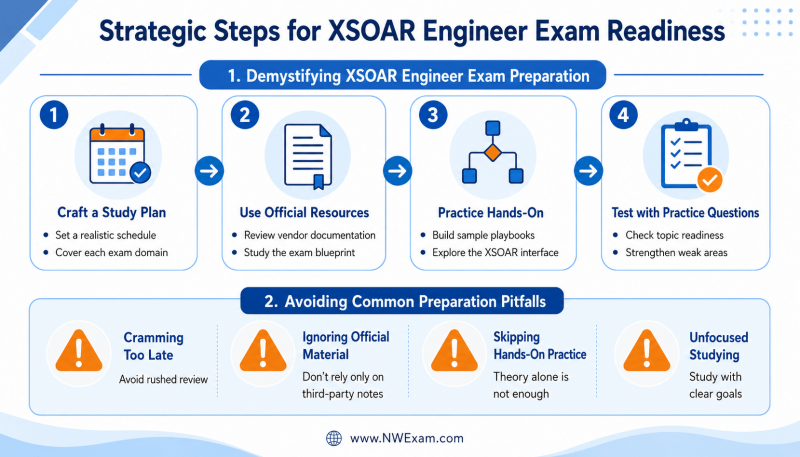
Preparing for the Palo Alto Networks XSOAR-Engineer certification demands a structured approach, blending theoretical knowledge with extensive hands-on experience. Success hinges not just on memorization, but on a deep, intuitive understanding of how XSOAR functions in real-world security operations. Candidates must commit to a comprehensive study strategy that covers all facets of the platform, ensuring they are well-versed in both its capabilities and its practical applications. This certification is a testament to genuine expertise, not just exam-taking prowess.
Crafting an Effective Study Plan
A well-defined study plan is the bedrock of successful certification attainment. Begin by reviewing the official exam objectives (if available) to identify key knowledge domains. Structure your study time to allocate sufficient focus to each area, especially those where your current experience might be limited. Break down complex topics into manageable chunks and set realistic milestones for your progress.
Consider the following components for your plan:
-
Conceptual Review: Understand the core SOAR concepts, XSOAR architecture, and automation principles.
-
Documentation Deep Dive: Thoroughly read through Palo Alto Networks official documentation, administration guides, and technical whitepapers related to XSOAR.
-
Hands-On Labs: Critically, dedicate significant time to working with the XSOAR platform. Experiment with playbooks, integrations, and custom content development in a lab environment.
Consistency is key; regular, focused study sessions are more effective than sporadic cramming. Integrate short quizzes or self-assessment checks into your routine to gauge retention and identify areas needing further attention.
Leveraging Official Palo Alto Networks Resources
Palo Alto Networks provides a wealth of resources specifically designed to aid in certification preparation. These official materials are invaluable as they align directly with the exam's focus areas and provide the most accurate information. Candidates should prioritize these resources over unofficial or unverified content.
Essential official resources include:
-
Training Courses: Enroll in official Palo Alto Networks XSOAR training courses, which offer structured learning paths and expert instruction. These courses often include labs and practical exercises.
-
Product Documentation: Access the comprehensive online documentation for XSOAR. This is your definitive guide for understanding features, configurations, and best practices.
-
Community Forums: Engage with the Palo Alto Networks XSOAR community. These forums can be a source of practical tips, troubleshooting advice, and discussions on advanced topics.
For a detailed breakdown of what to expect and additional support, always refer to the official Palo Alto Networks resources for the XSOAR Engineer certification.
Practice Makes Perfect: Sample Questions
Engaging with practice questions is an indispensable part of your preparation strategy. These questions help you familiarize yourself with the exam format, question types, and time management. They also serve as a diagnostic tool, highlighting areas where your understanding may be weak and requiring additional study.
When using practice questions:
-
Treat them as a simulated exam experience to build stamina and confidence.
-
Analyze incorrect answers thoroughly to understand the underlying concepts you missed.
-
Don't just memorize answers; strive to understand the reasoning behind each correct option.
While practice questions are helpful, beware of "exam dumps" which contain illegally sourced questions. Relying on such materials is unethical and can lead to a false sense of security, as they do not test your actual understanding and may contain outdated or incorrect information. Focus on genuine learning and skill development.
Avoiding Common Preparation Pitfalls
Many candidates approach certification exams with good intentions but fall into common traps that hinder their progress. For an advanced certification like the Palo Alto Networks XSOAR Engineer, avoiding these pitfalls is just as crucial as dedicated study. It ensures that your effort is efficiently directed towards genuine skill acquisition and exam readiness, rather than wasted on ineffective strategies.
Beyond Rote Memorization
The XSOAR-Engineer exam is designed to test practical application and problem-solving skills, not just the ability to recall facts. Simply memorizing commands, playbook steps, or integration names without understanding their context and purpose will likely lead to failure. The platform is dynamic, and scenarios presented in the exam often require critical thinking and an understanding of how different components interact.
Instead of rote memorization, focus on:
-
Conceptual Understanding: Grasp the 'why' behind each XSOAR feature and its role in a broader security strategy.
-
Scenario Analysis: Practice analyzing real-world security incidents and designing appropriate XSOAR automation solutions.
-
Troubleshooting Skills: Develop the ability to diagnose and resolve issues within XSOAR playbooks and integrations.
This approach fosters a deeper, more resilient knowledge base that will serve you well beyond the exam itself, in actual job performance.
Embracing Hands-On XSOAR Experience
Perhaps the most significant pitfall is neglecting sufficient hands-on experience. Theoretical knowledge alone is insufficient for this certification. XSOAR is a complex, feature-rich platform, and true mastery comes from extensive practical engagement. Without logging hours in a lab environment, many concepts will remain abstract and challenging to apply under exam conditions.
Candidates should:
-
Set Up a Lab: Utilize a trial version of XSOAR or a dedicated lab environment to perform configurations, build playbooks, and integrate simulated tools.
-
Recreate Scenarios: Attempt to automate various security scenarios, from simple alert enrichment to complex multi-tool incident response.
-
Experiment with Customizations: Practice writing custom Python scripts for integrations and commands, understanding how to extend XSOAR's capabilities.
This immersive approach builds muscle memory, solidifies understanding of workflow logic, and prepares you for the practical, scenario-based questions that are characteristic of advanced certification exams.
Achieving Certification: The XSOAR Engineer Journey
The journey to becoming a certified Palo Alto Networks XSOAR Engineer culminates in successfully passing the XSOAR-Engineer exam. This final step is a demonstration of your comprehensive understanding and practical command of the XSOAR platform. Approaching the exam day with confidence and a clear strategy is just as important as the months of preparation leading up to it.
Understanding the Exam Experience
While specific exam details (like duration or number of questions) are not provided here, candidates should generally anticipate a challenging assessment that combines multiple-choice, multiple-select, and potentially scenario-based questions. The exam aims to test both your conceptual knowledge and your ability to apply XSOAR principles to solve practical problems. Familiarizing yourself with the general format of professional certification exams, even if not XSOAR-specific, can help reduce anxiety.
During the exam, time management is critical. Read each question carefully, paying close attention to keywords and constraints. If a question seems particularly difficult, make an educated guess and flag it for review if time permits. Trust your preparation and avoid overthinking.
Maintaining Your XSOAR Expertise
Achieving the XSOAR Engineer certification is not the end, but rather a significant milestone in a continuous learning journey. The cybersecurity landscape, and specifically the XSOAR platform, evolves rapidly with new features, integrations, and threat intelligence. Maintaining your expertise requires ongoing commitment to staying current.
Strategies for continuous learning include:
-
Regular Platform Engagement: Continuously work with the XSOAR platform, exploring new features and updates.
-
Community Involvement: Participate in Palo Alto Networks user groups, webinars, and online communities to share knowledge and learn from peers.
-
Official Updates: Follow Palo Alto Networks blogs, release notes, and documentation updates for XSOAR.
-
Advanced Projects: Take on more complex automation projects within your organization to deepen your practical skills and explore advanced use cases.
Recertification requirements, if any, should also be monitored through official Palo Alto Networks channels to ensure your credential remains active and valid.
Strategic Insights for XSOAR Implementation
Beyond the technical mechanics, a true XSOAR Engineer guru understands the strategic implications of their work. Successful XSOAR implementation isn't just about building playbooks; it's about aligning automation with business goals, continuously optimizing performance, and demonstrating tangible value. These strategic insights elevate an engineer from a mere practitioner to a vital contributor to an organization's overall security posture and operational efficiency.
Optimizing SOAR Workflows
Optimization is an ongoing process that ensures SOAR workflows remain efficient, effective, and relevant. This involves regularly reviewing playbook performance, identifying bottlenecks, and refining automation logic. An XSOAR Engineer constantly seeks ways to make playbooks faster, more accurate, and more robust in the face of evolving threats and system changes.
Key optimization considerations include:
-
Performance Monitoring: Utilizing XSOAR's analytics and reporting features to track playbook execution times, success rates, and resource consumption.
-
Error Handling: Building resilient playbooks with robust error handling mechanisms to gracefully manage unexpected inputs or integration failures.
-
Scalability: Designing playbooks and integrations with scalability in mind, ensuring they can handle increasing volumes of alerts and data without degradation.
The goal is to move towards a "set it and forget it" ideal, where human intervention is minimized to only the most complex, nuanced security events.
Measuring Automation ROI
Demonstrating the return on investment (ROI) for SOAR initiatives is crucial for securing continued stakeholder support and investment. An XSOAR Engineer should be able to quantify the benefits of automation, translating technical achievements into business value. This involves tracking metrics that illustrate improvements in efficiency, cost savings, and risk reduction.
Relevant metrics often include:
-
Reduced Mean Time To Respond (MTTR): The time taken to detect, investigate, and remediate security incidents.
-
Decreased Manual Effort: Hours saved by automating tasks previously performed manually by security analysts.
-
Improved Incident Accuracy: Reduction in false positives and an increase in the fidelity of incident investigations.
-
Risk Mitigation: Quantifying the impact of faster containment and remediation on potential financial and reputational damage from breaches.
Effectively communicating these metrics positions the XSOAR Engineer as a strategic asset, capable of driving measurable improvements in the security posture.
The Future Landscape for XSOAR Engineers
The role of the Palo Alto Networks XSOAR Engineer is not static; it is constantly evolving alongside the cybersecurity threat landscape and technological advancements. Tomorrow's SOAR experts will need to adapt to new challenges, integrate emerging technologies, and continue to push the boundaries of automation. Understanding these future trends is essential for long-term career success and for maintaining a cutting edge in security operations.
Evolving Threats and SOAR Adaptability
Cyber adversaries are continuously refining their tactics, techniques, and procedures (TTPs). As threats become more sophisticated and automated, SOAR platforms like XSOAR must also adapt. This requires engineers to stay informed about the latest threat intelligence, understand new attack vectors, and be agile in updating playbooks and automation logic to counter these evolving threats.
Future XSOAR Engineers will increasingly work with challenges such as:
-
AI/ML-Powered Attacks: Developing playbooks that can detect and respond to attacks augmented by artificial intelligence.
-
Cloud-Native Security: Orchestrating responses across diverse cloud environments and integrating with cloud-specific security tools.
-
Supply Chain Risks: Building automation to monitor and respond to threats originating from third-party supply chains.
The ability to rapidly integrate new threat intelligence and adapt playbooks will be a defining characteristic of expert XSOAR Engineers.
Continuous Learning in Cybersecurity
The cybersecurity field demands continuous learning, and this is especially true for XSOAR Engineers. New vulnerabilities, technologies, and compliance requirements emerge constantly. Professionals must commit to ongoing education to remain proficient and relevant. This proactive approach to skill development ensures they can leverage the full potential of XSOAR and other SOAR technologies to secure complex enterprise environments.
This includes:
-
Exploring advanced scripting languages and automation frameworks.
-
Delving into cloud security, DevOps security, and zero-trust architectures.
-
Understanding the regulatory landscape and how automation can aid in compliance.
-
Engaging with cybersecurity research and industry best practices.
By embracing a mindset of perpetual learning, XSOAR Engineers can ensure they remain at the forefront of security automation, delivering unparalleled value to their organizations.
Conclusion
The Palo Alto Networks XSOAR Engineer certification is more than a credential; it's a testament to profound expertise in a rapidly evolving and critically important domain. By mastering the XSOAR platform, certified professionals are equipped to revolutionize security operations, automate incident response, and build resilient defenses against an ever-changing threat landscape. This journey demands dedication, hands-on experience, and a commitment to continuous learning, distinguishing individuals who are truly capable of elevating an organization's security posture.
For those ready to embark on this transformative path or to further enhance their existing SOAR skills, comprehensive resources and structured preparation are indispensable. Unlock your full potential and become a leader in security automation. Start your Palo Alto Networks XSOAR Engineer preparation today to secure your place among the industry's elite.
Frequently Asked Questions
1. What does the Palo Alto Networks XSOAR Engineer certification validate?
The Palo Alto Networks XSOAR Engineer certification validates a professional's expertise in designing, implementing, and managing security orchestration, automation, and response (SOAR) solutions using the Palo Alto Networks XSOAR platform.
2. Who should pursue the XSOAR Engineer certification?
This certification is ideal for security analysts, incident responders, security engineers, and automation specialists who are responsible for implementing and optimizing SOAR technologies within their organizations.
3. How does the XSOAR Engineer certification benefit a career?
Earning this certification enhances career prospects by validating in-demand SOAR skills, leading to advanced roles, higher earning potential, and recognition as an expert in security automation and incident response.
4. What kind of preparation is recommended for the XSOAR-Engineer exam?
Recommended preparation includes formal training courses, thorough review of official documentation, extensive hands-on practice with the XSOAR platform in a lab environment, and working through practice questions.
5. Is continuous learning important after achieving XSOAR Engineer certification?
Yes, continuous learning is crucial. The cybersecurity landscape and XSOAR platform evolve rapidly, requiring certified professionals to stay updated on new features, integrations, and threat intelligence to maintain their expertise and credentials.
- XSOAR-Engineer |
- XSOAR Engineer Certification Mock Test |
- XSOAR Engineer Mock Exam |
- XSOAR Engineer Practice Test |
- Palo Alto XSOAR Engineer Primer |
- XSOAR Engineer Simulator |
- XSOAR Engineer Study Guide |
- XSOAR Engineer |
- Palo Alto XSOAR-Engineer Question Bank |
- PAN XSOAR Engineer Exam Questions |
- Palo Alto PAN XSOAR Engineer Questions |
- Palo Alto Networks XSOAR Engineer |
- Palo Alto PAN XSOAR Engineer Practice Test |
- Palo Alto Networks Certified XSOAR Engineer |
- XSOAR-Engineer Syllabus |
- XSOAR Engineer Books |
- XSOAR Engineer Certification Cost |
- XSOAR Engineer Certification Syllabus |
- Palo Alto XSOAR Engineer Training |
- Palo Alto XSOAR-Engineer Books |
- Palo Alto PAN XSOAR Engineer Books |
- XSOAR Engineer Sample Questions |
- Palo Alto XSOAR-Engineer Practice Test Free |
- PAN XSOAR Engineer Certification Questions and Answers |
- PAN XSOAR Engineer Certification Sample Questions


