
Conquer FCP_FAZ_AN-7.6: Your Pass-Proof Action Plan

The Fortinet NSE 5 - FortiAnalyzer 7.6 Analyst certification, identified by exam code FCP_FAZ_AN-7.6, validates a candidate's proficiency in using FortiAnalyzer for centralized logging, analytics, and reporting of Fortinet security devices. This credential is designed for security analysts, network administrators, and IT professionals responsible for monitoring and analyzing security events within Fortinet environments. This comprehensive guide outlines the exam objectives, structure, and a robust preparation strategy to help you effectively prepare for and pass the FCP_FAZ_AN-7.6 exam, ensuring you possess the skills to leverage FortiAnalyzer 7.6’s powerful capabilities.
Understanding the FCP_FAZ_AN-7.6 Certification
The Fortinet Certified Professional (FCP) in Security Operations designation signifies a professional’s ability to implement, administer, and monitor Fortinet security products. Achieving the Fortinet NSE 5 certification, specifically the FortiAnalyzer 7.6 Analyst, demonstrates your expertise in utilizing FortiAnalyzer for critical security operations. This certification is a pivotal step for those aiming to strengthen their security analysis skills and contribute effectively to threat detection and incident response using Fortinet's advanced logging and reporting solutions. For a broader understanding of the FCP Security Operations path, explore the official Fortinet FCP Security Operations page.
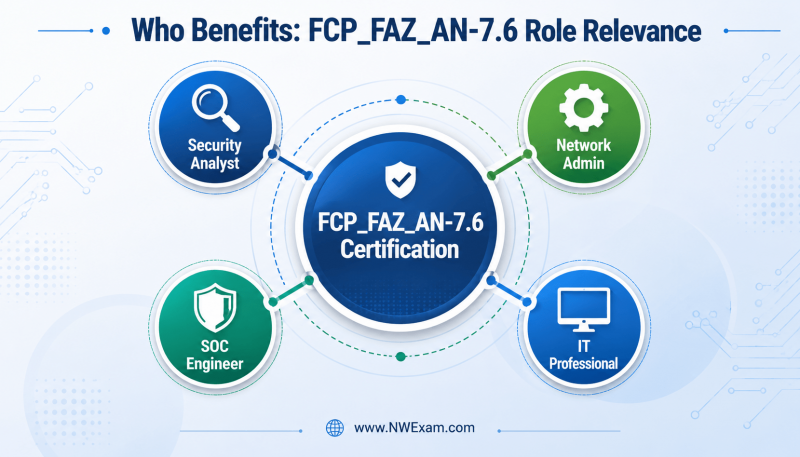
Who Benefits from FCP_FAZ_AN-7.6?
This certification is particularly valuable for individuals who regularly interact with FortiAnalyzer in a professional capacity. It is ideal for:
-
Security Analysts: Those tasked with monitoring network activity, identifying anomalies, and responding to security incidents.
-
Network Administrators: Professionals responsible for the configuration and maintenance of Fortinet security infrastructure, requiring insight into network behavior.
-
SOC Engineers: Individuals working in Security Operations Centers, who rely on robust SIEM capabilities for threat hunting and compliance reporting.
-
IT Professionals: Anyone seeking to validate their expertise in FortiAnalyzer 7.6 and enhance their career prospects in cybersecurity.
The FCP_FAZ_AN-7.6 is a testament to your capability to manage and interpret security data, a crucial skill in today's threat landscape.
Exploring the FCP_FAZ_AN-7.6 Exam Details
Grasping the logistical aspects of the FCP_FAZ_AN-7.6 exam is the first step in constructing a solid study plan. Knowing what to expect on exam day helps alleviate stress and allows for targeted preparation. The Fortinet NSE 5 - FortiAnalyzer 7.6 Analyst exam is a crucial evaluation of your practical skills and theoretical knowledge.
The key details are as follows:
-
Exam Name: Fortinet NSE 5 - FortiAnalyzer 7.6 Analyst
-
Exam Code: FCP_FAZ_AN-7.6 FortiAnalyzer Analyst
-
Duration: 65 minutes
-
Number of Questions: 30-35
-
Passing Score: Pass / Fail
-
Exam Price: $200 USD
This format indicates a fast-paced assessment requiring quick recall and application of knowledge. Each question contributes to your overall pass/fail status, emphasizing comprehensive understanding across all topics.
Unpacking the FortiAnalyzer 7.6 Analyst Syllabus
The FCP_FAZ_AN-7.6 exam syllabus is meticulously structured to ensure candidates are tested on all critical aspects of FortiAnalyzer 7.6. A deep dive into each topic area helps in allocating study time efficiently and focusing on key concepts. Each domain represents a fundamental component of effective FortiAnalyzer operation and security analysis.
Core Features and Concepts of FortiAnalyzer
This section lays the groundwork for understanding FortiAnalyzer's role within the Fortinet security fabric. It covers the foundational elements necessary to operate the platform effectively.
- Features and concepts: Candidates must understand the overall architecture, deployment options, and core functionalities of FortiAnalyzer. This includes its integration with other Fortinet devices, data flow, and how it contributes to a comprehensive security posture. Knowledge of FortiAnalyzer's scalability, high availability, and licensing models is also critical here.
This foundational knowledge ensures you can strategically position and utilize FortiAnalyzer in various network environments.
Mastering Log Analysis with FortiAnalyzer
Log analysis is at the heart of security operations, and FortiAnalyzer excels in this area. This part of the syllabus focuses on your ability to extract meaningful insights from vast amounts of log data.
- Log Analysis: This topic requires proficiency in collecting, storing, and analyzing logs from diverse Fortinet devices like FortiGate, FortiProxy, and FortiClient. It includes understanding different log types (traffic, event, security), log filters, and advanced search queries. Candidates should be able to identify relevant security events, trace attack paths, and perform forensic analysis using the FortiAnalyzer interface.
Effective log analysis skills are paramount for detecting threats and understanding network behavior.
Enhancing SOC Operations and Automation
FortiAnalyzer is not just a logging tool; it's a powerful component for Security Operations Center (SOC) efficiency. This section delves into how the platform supports and automates security workflows.
- SOC operation and automation: This involves utilizing FortiAnalyzer's capabilities to streamline SOC activities. Key areas include creating custom event handlers, configuring alerts and notifications, and integrating with other security tools via API. Understanding how to build playbooks and automated responses within FortiAnalyzer to react to specific security incidents is also crucial. This topic also covers incident management features and the ability to track security events through their lifecycle.
Automation significantly reduces response times and improves the overall effectiveness of a SOC.
Generating Actionable Security Reports
Reporting is vital for communicating security posture, demonstrating compliance, and informing decision-making. This segment focuses on creating comprehensive and customized reports.
- Reports: Candidates need to be adept at generating various types of reports, including compliance reports, executive summaries, and detailed technical reports. This involves understanding report templates, customization options, scheduling reports, and exporting them in different formats. Knowledge of how to create custom datasets and charts to visualize specific security metrics is also essential for this topic.
Well-structured reports transform raw data into clear, actionable intelligence for stakeholders.
Developing a Strategic FCP_FAZ_AN-7.6 Study Regimen
Preparing for the FCP_FAZ_AN-7.6 exam demands a structured and consistent approach. A well-thought-out study plan is your most valuable asset. It’s not just about memorizing facts but understanding the practical application of FortiAnalyzer 7.6’s features.
Official Training and Documentation Utilization
Fortinet provides excellent resources designed specifically for this certification. Leveraging these materials is non-negotiable for success.
-
Fortinet Official Training: Enroll in the official "Fortinet NSE 5 - FortiAnalyzer 7.6 Analyst course" if available. These courses are designed to align directly with the exam objectives and often include hands-on labs that reinforce theoretical concepts.
-
Fortinet Documentation: Immerse yourself in the official FortiAnalyzer administration guides, release notes, and technical documentation. These resources offer the most accurate and up-to-date information on features, configurations, and best practices. Pay close attention to sections detailing FortiAnalyzer 7.6 features and benefits, FortiAnalyzer 7.6 logging and reporting, and FortiAnalyzer 7.6 SIEM capabilities.
These resources provide the authoritative voice on FortiAnalyzer functionality and exam expectations.
Hands-On Practice and Lab Environments
Theoretical knowledge alone is insufficient. Practical experience with FortiAnalyzer 7.6 is critical for solidifying your understanding and preparing for scenario-based questions.
-
Set up a Lab Environment: If possible, create a virtual lab environment where you can install FortiAnalyzer 7.6 and integrate it with virtual FortiGate devices. This allows you to practice configurations, log collection, report generation, and automation scripts in a real-world simulated setting.
-
Practice Scenarios: Work through common security analysis scenarios. For instance, practice investigating a suspected breach using log data, configuring custom alerts for specific threat indicators, or building detailed compliance reports. This hands-on application reinforces FortiAnalyzer 7.6 dashboard and monitoring skills.
Active engagement with the platform helps translate concepts into practical skills.
Utilizing Practice Tests for Assessment
Practice tests are invaluable for gauging your readiness and identifying areas that require further attention. They simulate the actual exam experience and help you manage your time effectively.
-
FCP_FAZ_AN-7.6 Practice Test: Take advantage of high-quality practice tests specific to the FCP_FAZ_AN-7.6 exam. These tests help you become familiar with the question types, pacing, and overall structure of the assessment. They also provide an opportunity to refine your understanding of Fortinet NSE 5 FortiAnalyzer exam questions.
-
Review Explanations: After completing a practice test, thoroughly review both correct and incorrect answers, especially those with detailed explanations. This process helps clarify misconceptions and deepens your understanding of the underlying principles. You can find comprehensive practice questions for the Fortinet FCP FortiAnalyzer certification on a reputable platform like NWExam.
Regular practice test sessions are key to building confidence and exam-day readiness.
FortiAnalyzer 7.6 Capabilities for Security Analysts
FortiAnalyzer 7.6 goes beyond basic log management, offering a suite of powerful features essential for modern security operations. Understanding these capabilities is fundamental to passing the FCP_FAZ_AN-7.6 exam and excelling in a security analyst role.
Advanced Threat Detection and SIEM Integration
FortiAnalyzer 7.6 provides robust capabilities for identifying and responding to sophisticated threats, functioning as a critical component in a security information and event management (SIEM) strategy.
-
Enhanced Threat Intelligence: Leverage integrated FortiGuard threat intelligence to identify known malicious indicators within your network logs. This includes real-time updates on botnets, malware, and other cyber threats.
-
Customizable Event Handlers: Configure specific rules to detect unusual patterns or suspicious activities. These event handlers can trigger alerts, quarantine infected devices, or execute scripts for automated responses, forming the backbone of FortiAnalyzer 7.6 SIEM capabilities.
-
Correlation and Anomaly Detection: Utilize FortiAnalyzer's ability to correlate events from multiple devices to identify complex attack sequences that might otherwise go unnoticed. Its anomaly detection engines can flag deviations from baseline network behavior.
These features empower analysts to move from reactive to proactive threat management.
Streamlined Reporting and Compliance Auditing
Effective reporting is crucial for demonstrating compliance, communicating security posture, and making informed decisions. FortiAnalyzer 7.6 offers extensive reporting tools to meet these needs.
-
Predefined and Custom Reports: Access a library of predefined reports for various compliance standards (e.g., PCI DSS, HIPAA) and security best practices. The platform also allows for extensive customization, enabling you to build reports tailored to specific organizational requirements.
-
Automated Report Generation: Schedule reports to run automatically at desired intervals and be delivered to relevant stakeholders. This ensures timely updates on security status without manual intervention.
-
Data Visualization and Dashboards: Utilize intuitive dashboards with customizable widgets to visualize key security metrics, network activity, and threat landscapes. This provides at-a-glance insights into your security environment, crucial for FortiAnalyzer 7.6 dashboard and monitoring.
These reporting features transform raw data into digestible, actionable intelligence for both technical and non-technical audiences.
Fortinet NSE 5 Certification Path Advancement
The FCP_FAZ_AN-7.6 certification is not an isolated achievement but a stepping stone within the broader Fortinet certification ecosystem. Understanding its place in the Fortinet NSE 5 certification path can help you plan your career progression.
Progression within the NSE Program
The Fortinet NSE 5 program focuses on your ability to implement, administer, and monitor Fortinet security products, requiring two elective exams. Passing FCP_FAZ_AN-7.6 fulfills one of these requirements, making it a critical component of your security operations expertise. This exam, specifically targeting FortiAnalyzer, complements other NSE 5 exams that cover different Fortinet products such as FortiManager, FortiClient EMS, FortiEDR, and FortiSIEM. By accumulating NSE 5 certifications, you build a comprehensive skill set in managing Fortinet's diverse security solutions, furthering your journey towards becoming a well-rounded Fortinet security analyst. For more details on the overall certification framework, refer to the official Fortinet training page.
Career Impact and Professional Recognition
Earning the FCP_FAZ_AN-7.6 certification significantly enhances your professional credibility and marketability. It signals to employers that you possess specialized skills in a highly demanded area of cybersecurity. This credential can lead to opportunities in roles such as:
-
Senior Security Analyst
-
SOC Engineer
-
Incident Response Specialist
-
Network Security Administrator
-
Security Consultant
The certification not only validates your technical skills but also demonstrates a commitment to continuous professional development in the rapidly evolving field of cybersecurity.
Conclusion
Conquering the FCP_FAZ_AN-7.6 exam is a testament to your expertise in leveraging FortiAnalyzer 7.6 for advanced security operations. By following a disciplined study plan that incorporates official training, hands-on practice, and rigorous self-assessment, you can confidently approach the exam. This certification not only validates your technical prowess but also elevates your standing as a Fortinet security analyst, equipping you with the critical skills to analyze threats, automate responses, and report on security posture effectively.
Embark on your journey to Fortinet NSE 5 certification today by dedicating yourself to a thorough and ethical preparation strategy. To validate your readiness and familiarize yourself with the FCP_FAZ_AN-7.6 exam questions, explore high-quality practice tests and sample questions available at Fortinet FCP_FAZ_AN-7.6 exam preparation. Invest in your professional development and solidify your position as a skilled cybersecurity professional.
Frequently Asked Questions
1. Is FCP_FAZ_AN-7.6 difficult?
The exam is moderately challenging. Candidates with hands-on FortiAnalyzer experience typically find the concepts manageable.
2. What is the best FCP_FAZ_AN-7.6 practice test strategy?
Take multiple full-length practice exams, review explanations, and focus on weak objectives.
3. How long should I study for FCP_FAZ_AN-7.6?
Most candidates prepare for 4 to 8 weeks depending on prior experience.
4. What are the most important Fortinet NSE 5 - FortiAnalyzer 7.6 exam topics?
Logging, reporting, event management, analytics, dashboards, and incident investigation are key focus areas.
5. Is official Fortinet training necessary?
It is highly recommended because it aligns closely with exam objectives and product workflows.
6. What career opportunities can this certification support?
It supports roles in security operations, SOC analysis, incident response, and cybersecurity administration.
7. Does hands-on practice matter?
Yes. Practical experience significantly improves understanding and exam performance.
8. How often should I take practice exams?
Begin after covering core objectives and continue weekly until consistently achieving passing scores.
- FortiAnalyzer Analyst Certification Mock Test |
- FortiAnalyzer Analyst Mock Exam |
- FortiAnalyzer Analyst Practice Test |
- Fortinet FortiAnalyzer Analyst Primer |
- FortiAnalyzer Analyst Simulator |
- FortiAnalyzer Analyst Exam Questions |
- Fortinet FortiAnalyzer Analyst Questions |
- Fortinet FortiAnalyzer Analyst Practice Test |
- FortiAnalyzer Analyst Books |
- FortiAnalyzer Analyst Certification Cost |
- FortiAnalyzer Analyst Certification Syllabus |
- Fortinet FortiAnalyzer Analyst Training |
- Fortinet FortiAnalyzer Analyst Books |
- FortiAnalyzer Analyst Sample Questions |
- FortiAnalyzer Analyst Certification Questions and Answers |
- FortiAnalyzer Analyst Certification Sample Questions |
- FCP_FAZ_AN-7.6 |
- Fortinet NSE 5 - FortiAnalyzer Analyst |
- FCP_FAZ_AN-7.6 Syllabus |
- Fortinet FCP_FAZ_AN-7.6 Books |
- Fortinet FCP_FAZ_AN-7.6 Practice Test Free


