
The Definitive Palo Alto NetSec-Architect Strategy

Palo Alto Networks Certified Network Security Architect, validated by the NetSec-Architect exam, signifies a professional's advanced capability in designing, implementing, and optimizing comprehensive security architectures. This credential positions individuals as experts in securing complex enterprise environments using Palo Alto Networks solutions. Designed for experienced security professionals, this article offers a structured, practical, and supportive guide to master the NetSec-Architect exam objectives and achieve certification. It delves into the core domains, strategic preparation techniques, and the tangible benefits of becoming a Palo Alto Networks Certified Network Security Architect.
Evaluating the Palo Alto NetSec-Architect Certification
The Palo Alto Network Security Architect certification, identified by exam code NetSec-Architect, validates an individual's expertise in designing and deploying Palo Alto Networks-driven secure network architectures. This certification is ideal for senior security engineers, architects, and consultants responsible for complex security implementations across various environments. Earning this credential confirms proficiency in advanced security concepts and their practical application with Palo Alto Networks technologies.
The NetSec-Architect exam, priced at $300 USD, assesses candidates over a duration of 90 minutes. It comprises 80 questions and requires a passing score of 860 on a scale of 300 to 1000. These metrics highlight the comprehensive nature and depth of knowledge expected from certified professionals. Successfully navigating this exam demonstrates a robust understanding of modern security challenges and architectural solutions.
Defining the Network Security Architect's Responsibilities
A Palo Alto Networks Certified Network Security Architect plays a pivotal role in an organization's defense posture. These professionals are responsible for translating business requirements into secure, scalable, and resilient network designs leveraging the full spectrum of Palo Alto Networks products. Their duties extend beyond mere implementation, encompassing strategic planning, risk assessment, and continuous optimization of the security infrastructure. They are often key decision-makers in adopting next-generation firewall architecture and implementing Zero Trust security models.
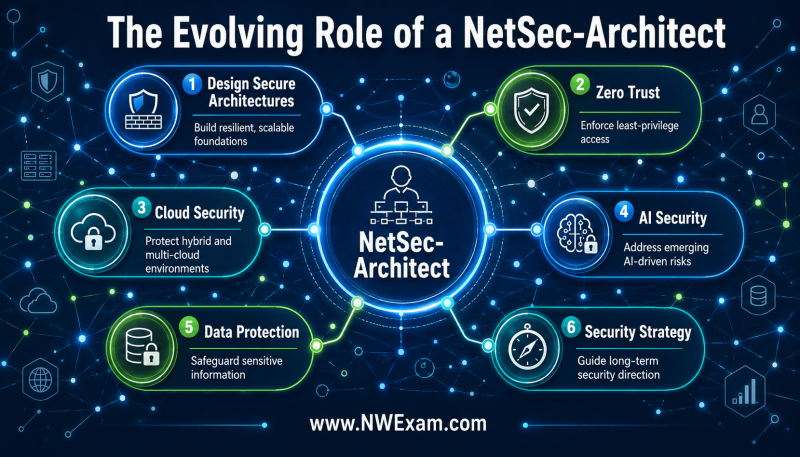
The role demands a deep understanding of evolving threat landscapes and the ability to proactively design defenses. This involves integrating various security components, ensuring compliance, and providing strategic guidance to security teams. Professionals pursuing the NetSec-Architect certification should already possess significant experience in hands-on network security roles and be ready to elevate their expertise to an architectural level.
Dissecting the NetSec-Architect Exam Blueprint
Achieving the Palo Alto NetSec-Architect certification requires a thorough understanding of a broad spectrum of advanced security domains. The exam syllabus reflects the multi-faceted nature of modern network security architecture, encompassing cloud, AI, IoT, and core network principles. Each domain carries a specific weight, indicating its importance in the overall assessment. A strategic study plan must allocate time commensurate with these weightings to ensure comprehensive coverage.
The exam content is designed to validate a candidate's ability to design secure network architectures, integrating Palo Alto Networks solutions effectively. From securing private applications to managing public cloud deployments, the syllabus covers the critical areas a network security architect encounters daily. For an in-depth understanding of the topics and their nuances, candidates should refer to the detailed exam blueprint datasheet.
Mastering Zero Trust Enterprise Concepts (8%)
The Zero Trust Enterprise segment, weighted at 8%, focuses on designing and implementing Zero Trust principles within an organization. This involves understanding the core tenets of "never trust, always verify" and how to apply them across users, devices, applications, and networks. Candidates must be able to architect solutions that enforce least-privilege access, continuous verification, and micro-segmentation, fundamentally reshaping traditional perimeter-based security models. This domain is crucial for professionals aspiring to become a Palo Alto Networks Zero Trust security architect, as it lays the foundation for modern security paradigms.
Architects need to demonstrate proficiency in integrating Palo Alto Networks products to achieve Zero Trust objectives, including identity and access management (IAM), next-generation firewalls (NGFWs), and endpoint security. Understanding how these components work in concert to establish granular access controls and policy enforcement is key to success in this section.
Understanding AI Security Implementations (11%)
AI Security accounts for 11% of the exam, emphasizing the architectural considerations for securing AI/ML environments and leveraging AI for security operations. This domain requires knowledge of how to protect AI models and data from adversarial attacks, ensuring the integrity and confidentiality of AI-driven systems. Conversely, it also covers how AI can be integrated into security solutions to enhance threat detection, incident response, and anomaly analysis.
For a network security architect, this involves designing infrastructures that support AI workloads securely, implementing AI-powered security features, and understanding the risks associated with AI adoption. Familiarity with AI-driven threat intelligence and automation capabilities within Palo Alto Networks platforms will be highly beneficial.
Centralized Management and IAM Strategies (13%)
Centralized Management and IAM (Identity and Access Management) is the highest weighted domain at 13%. This section covers the design and implementation of unified management platforms like Panorama, along with robust identity and access strategies. Candidates must demonstrate the ability to architect solutions that ensure consistent policy enforcement, simplified management, and secure access across distributed network environments.
Key topics include integrating third-party identity providers, implementing multi-factor authentication (MFA), and designing role-based access control (RBAC) within Palo Alto Networks ecosystems. A strong grasp of managing large-scale deployments, automating security operations, and maintaining a clear audit trail for all network activities is essential for this critical domain.
Securing SSE Private Application Access (11%)
The SSE Private Application Access domain, also at 11%, focuses on designing secure access solutions for private applications using Security Service Edge (SSE) principles. This involves understanding how to provide secure, direct-to-app access for remote users, bypassing traditional VPN architectures while maintaining full security posture. Architects must be capable of designing and implementing the necessary components for a robust SSE framework that minimizes attack surface and enhances user experience.
Topics include the deployment of Zero Trust Network Access (ZTNA) with Prisma Access or equivalent solutions, ensuring application-level segmentation, and enforcing context-aware policies. The ability to articulate the benefits of SSE over legacy access methods and design for high availability and performance is critical for this section.
Architecting Mobile User Security (7%)
Mobile User Security, representing 7% of the exam, covers the architectural approaches to securing mobile users and devices. This domain addresses the unique challenges posed by a mobile workforce, including securing endpoints, enforcing consistent security policies regardless of location, and protecting data in transit and at rest on mobile devices. Architects must design solutions that provide comprehensive protection without impeding user productivity.
This section requires knowledge of secure connectivity solutions for mobile devices, mobile threat prevention, and integration with unified endpoint management (UEM) platforms. Understanding how Palo Alto Networks solutions extend security to the mobile edge is crucial for mastering this domain.
Optimizing Security for Modernizing Branches (11%)
Modernizing Branches, at 11%, addresses the architectural considerations for transforming traditional branch office security to meet the demands of cloud-first strategies and direct internet access. This involves moving away from backhauling traffic to central data centers and designing distributed security architectures at the branch level. Candidates must demonstrate the ability to implement solutions that provide consistent security and performance for branch users and applications.
Key concepts include SD-WAN security integration, local internet breakout with advanced threat prevention, and centralized management for branch security policies. Designing cost-effective, high-performing, and secure branch deployments using Palo Alto Networks technologies is the focus here.
Strategies for Data Security (7%)
The Data Security domain, weighted at 7%, covers architectural strategies for protecting sensitive data across the enterprise, both on-premises and in the cloud. This includes understanding data loss prevention (DLP) principles, data classification, and ensuring compliance with various regulatory requirements. Architects must design solutions that prevent unauthorized data exfiltration and maintain data integrity throughout its lifecycle.
This section focuses on implementing DLP policies, securing data at rest and in motion, and integrating data security controls with network and endpoint security solutions. A strong understanding of Palo Alto Networks' data security capabilities and how they contribute to an overall data protection strategy is essential.
Securing IoT Environments (11%)
Securing IoT Environments, at 11%, focuses on the unique challenges and architectural solutions for protecting Internet of Things (IoT) devices within the network. This involves identifying IoT devices, segmenting them, and enforcing specific security policies to mitigate their inherent vulnerabilities. Architects must design scalable and manageable security frameworks for diverse IoT deployments.
Topics include device discovery and profiling, policy enforcement based on device behavior, and preventing lateral movement of threats originating from compromised IoT devices. Knowledge of Palo Alto Networks' IoT security features and their integration into broader network security architecture is vital for this domain.
Public Cloud Security Architecture (11%)
Public Cloud security, accounting for 11% of the exam, requires candidates to design and implement secure architectures within public cloud environments (e.g., AWS, Azure, Google Cloud). This includes protecting workloads, data, and applications deployed in IaaS, PaaS, and SaaS models. Architects must understand cloud-native security constructs and how Palo Alto Networks solutions extend security into these dynamic environments.
Key areas involve deploying virtual firewalls (VM-Series), implementing cloud security posture management (CSPM), and securing containerized applications. Designing highly available and scalable cloud security solutions that adhere to best practices for a Palo Alto Networks secure network architecture design is a core competency assessed here. To truly understand the scope of public cloud security with Palo Alto, candidates should visit the official NetSec-Architect exam page for additional resources.
Private Cloud Security with PA-Series, VM-Series, Hypervisors (10%)
The Private Cloud domain, weighted at 10%, focuses on designing and implementing security architectures for on-premises private cloud environments, including virtualized infrastructures using PA-Series hardware, VM-Series virtual firewalls, and various hypervisor platforms. This section emphasizes the integration of physical and virtual security components to provide robust protection within enterprise data centers.
Candidates must demonstrate expertise in deploying and managing VM-Series firewalls on hypervisors like VMware ESXi, Nutanix AHV, or KVM, ensuring proper network segmentation, policy enforcement, and high availability. Understanding how to leverage automation and orchestration tools to streamline security operations in a private cloud setting is also an important aspect.
Crafting an Effective NetSec-Architect Preparation Journey
A successful Palo Alto NetSec-Architect preparation strategy demands more than just rote memorization; it requires a structured approach to learning and practical application. Begin by thoroughly reviewing the official exam objectives and syllabus to identify your strengths and weaknesses. This initial assessment will help tailor your study plan and allocate time efficiently across the ten distinct domains. Leveraging official Palo Alto Networks training courses and documentation is paramount for building a solid foundation.
Consider combining different learning modalities to reinforce concepts. This might include video lectures, hands-on labs, and collaborative study groups. The certification journey should be seen as an opportunity to deepen your expertise in Palo Alto Networks security architect job description tasks and real-world scenarios.
Strategic Study Material Selection
Choosing the right study materials is a critical step in preparing for the NetSec-Architect exam. Official Palo Alto Networks training, such as the Network Security Design and Implementation courses, provides the foundational knowledge and practical skills required. These courses are often taught by experienced instructors and offer comprehensive coverage of the technologies and architectural principles. Supplementing this with detailed product documentation, whitepapers, and best practice guides from Palo Alto Networks ensures you have access to the most current information.
Additionally, engaging with community forums and technical blogs can provide valuable insights and alternative perspectives on complex topics. Creating detailed notes and summaries for each syllabus domain will aid in retaining information and serve as quick reference guides during your study sessions. Prioritize resources that align directly with the stated exam objectives.
Importance of Hands-On Experience
Theoretical knowledge, while essential, must be complemented by extensive hands-on experience. The NetSec-Architect exam assesses not just what you know, but how you can apply that knowledge in real-world design scenarios. Setting up a lab environment, either virtual or physical, to deploy and configure Palo Alto Networks firewalls and other security solutions is invaluable. Practice designing secure network architectures, implementing complex policies, and troubleshooting common issues.
Working with various Palo Alto Networks products, including next-generation firewalls (NGFWs) and cloud security platforms, will solidify your understanding of their capabilities and integration points. This practical application directly correlates with the skills validated by the certification and is a non-negotiable component of a robust preparation plan.
Validating Your Exam Readiness
As you progress through your study plan, regularly validating your understanding and readiness is crucial for passing the Palo Alto NetSec-Architect exam. This involves a systematic approach to self-assessment, identifying knowledge gaps, and refining your skills. The goal is not just to answer questions correctly, but to comprehend the underlying architectural principles and design implications.
Leveraging Practice Questions and Mock Exams
Incorporating Palo Alto NetSec-Architect exam practice questions into your routine is an effective way to gauge your understanding and familiarize yourself with the exam format. These questions help reinforce concepts, highlight areas needing further study, and build confidence. It's important to use high-quality practice questions that accurately reflect the exam's difficulty and scope.
Mock exams, ideally timed and structured like the actual NetSec-Architect test, are invaluable for simulating the exam environment. They help in managing time effectively, reducing test anxiety, and identifying patterns in question types. After each practice test, thoroughly review both correct and incorrect answers to understand the reasoning behind them, rather than simply memorizing solutions. Platforms offering practice tests can provide structured reviews to enhance learning. You can explore relevant resources to support your preparation for Palo Alto Network Security certifications on Palo Alto Network Security certifications.
Embracing Ethical Preparation Practices
Maintaining ethical preparation practices is paramount throughout your certification journey. Relying on "exam dumps" or unauthorized materials not only undermines the integrity of the certification but also deprives you of genuine learning. The Palo Alto NetSec-Architect certification benefits are realized when candidates truly master the skills, not just pass an exam. Focus on understanding the concepts deeply, practicing with legitimate resources, and building a strong foundation of knowledge that will serve you well in your professional career.
Ethical preparation ensures that the credential genuinely reflects your capabilities as a Palo Alto Networks Certified Network Security Architect. This approach leads to sustainable career growth and the ability to confidently apply your expertise in real-world scenarios.
Unlocking Professional Growth with Palo Alto NetSec-Architect
Earning the Palo Alto NetSec-Architect certification offers significant professional advantages, positioning you as a highly skilled and sought-after expert in network security. This credential not only validates your technical prowess but also signals to employers your commitment to advanced security architecture and strategic thinking. The Palo Alto Networks Certified Network Security Architect salary often reflects the specialized nature of this role, commanding competitive compensation in the industry.
Beyond salary, the certification opens doors to leadership roles, greater project responsibilities, and opportunities to influence organizational security strategies. It underscores your ability to design and implement complex Palo Alto Networks security architecture, which is a critical asset for any enterprise.
Accelerating Career Trajectories
The NetSec-Architect certification can significantly accelerate your career trajectory within the cybersecurity domain. It demonstrates a mastery of advanced concepts in securing modern IT infrastructures, including public and private clouds, IoT, and AI-driven security. Professionals holding this certification are often tapped for critical projects involving secure network architecture design and strategic security initiatives. This elevated status can lead to promotions, new job opportunities, and enhanced recognition among peers and industry leaders.
Tangible Benefits for Organizations
For organizations, employing a Palo Alto Networks Certified Network Security Architect brings immediate and tangible benefits. These architects are equipped to design resilient and efficient security postures that protect critical assets against sophisticated threats. They can optimize existing security investments, ensure compliance with regulatory standards, and drive the adoption of best practices like Zero Trust. Their expertise translates directly into reduced risk, improved operational efficiency, and a stronger overall security stance, proving the substantial Palo Alto Networks Certified Network Security Architect benefits.
In conclusion, the Palo Alto NetSec-Architect certification represents a pinnacle achievement for network security professionals. It validates advanced skills in designing and implementing robust security architectures leveraging Palo Alto Networks solutions. By focusing on a structured study plan, hands-on experience, and ethical preparation, candidates can successfully navigate the challenging exam landscape. This credential not only enhances individual career prospects, including a competitive Palo Alto Networks Certified Network Security Architect salary, but also empowers organizations to build more resilient and secure digital environments.
To embark on this transformative journey, explore dedicated study resources and practice materials. Begin your journey today to elevate your expertise and explore advanced Palo Alto certification paths by visiting the Palo Alto NetSec-Architect certification page.
Frequently Asked Questions
1. What skills does the Palo Alto NetSec-Architect certification validate?
The Palo Alto NetSec-Architect certification validates a professional's advanced skills in designing, implementing, and optimizing comprehensive network security architectures using Palo Alto Networks solutions. It covers domains like Zero Trust, AI Security, cloud environments, and centralized management.
2. Is the NetSec-Architect exam challenging, and how is it scored?
Yes, the NetSec-Architect exam is considered challenging, requiring deep architectural knowledge. It consists of 80 questions to be completed in 90 minutes, and candidates need to achieve a score of 860 on a scale of 300 to 1000 to pass.
3. How does the NetSec-Architect certification benefit career progression?
This certification significantly benefits career progression by validating expertise in critical security architecture roles. It often leads to higher earning potential, positions in strategic security design, and opportunities to lead complex security projects, enhancing a professional's market value.
4. What is the recommended preparation approach for the Palo Alto NetSec-Architect exam?
A recommended approach includes leveraging official Palo Alto Networks training, gaining extensive hands-on experience with their security platforms, thoroughly studying the exam syllabus, and utilizing practice questions and mock exams for readiness assessment.
5. Are there any prerequisites for taking the Palo Alto NetSec-Architect exam?
While there are no strict prerequisites listed, candidates are typically expected to have significant experience in network security engineering or architecture roles and a strong foundational understanding of Palo Alto Networks technologies, often having achieved other Palo Alto certifications.
- NetSec-Architect |
- NetSec-Architect Certification Mock Test |
- Palo Alto NetSec-Architect Certification |
- NetSec-Architect Mock Exam |
- NetSec-Architect Practice Test |
- Palo Alto NetSec-Architect Primer |
- NetSec-Architect Simulator |
- NetSec-Architect Exam Questions |
- Palo Alto NetSec-Architect Questions |
- Palo Alto Network Security Architect |
- Palo Alto NetSec-Architect Practice Test |
- NetSec-Architect Syllabus |
- NetSec-Architect Books |
- NetSec-Architect Certification Cost |
- NetSec-Architect Certification Syllabus |
- Palo Alto NetSec-Architect Training |
- Palo Alto NetSec-Architect Books |
- NetSec-Architect Sample Questions |
- Palo Alto NetSec-Architect Practice Test Free |
- NetSec-Architect Certification Questions and Answers |
- NetSec-Architect Certification Sample Questions


