
90% Fail Here: Palo Alto SecOps-Pro Certification Pitfalls
The Palo Alto Security Operations Professional, or SecOps-Pro certification, is designed to validate the advanced skills of security professionals responsible for operating and optimizing Palo Alto Networks security platforms. This credential demonstrates a candidate's expertise in leveraging the Cortex XDR, Cortex XSOAR, and Cortex XSIAM suites for comprehensive threat detection, incident response, and security automation. Aspiring SecOps professionals aiming to secure critical infrastructure and data against evolving threats often pursue this certification, yet many encounter common pitfalls that hinder their success. This article explores these common mistakes. It offers both guidance and caution. The goal is to help candidates avoid common traps and improve their preparation strategy.
Grasping the SecOps-Pro Exam Landscape
Understanding the foundational aspects of the Palo Alto SecOps-Pro exam is the first step toward effective preparation. Many candidates overlook the structure and format, leading to surprises on exam day. The Palo Alto Networks SecOps Professional exam, identified by the exam code SecOps-Pro, assesses a broad range of operational security competencies. Familiarity with these logistical details allows for better planning and reduces anxiety.
The examination details are as follows:
-
Exam Name: Palo Alto Security Operations Professional
-
Exam Code: SecOps-Pro
-
Duration: 90 minutes
-
Number of Questions: 60-75 multiple-choice, multiple-response, and scenario-based questions.
-
Passing Score: Candidates must achieve 860 on a scale of 300 to 1000.
-
Exam Price: $200 USD
This structure necessitates not only deep technical knowledge but also efficient time management and strategic question-answering techniques. For further details on the certification and its benefits, candidates can explore the official certification page.
Navigating Core SecOps Professional Domains
A significant pitfall for many attempting the Palo Alto SecOps-Pro certification is an unbalanced approach to the syllabus topics. The exam demands a holistic understanding of Palo Alto Networks' security operations solutions, with specific weightings that guide where study efforts should be concentrated. Neglecting certain domains or underestimating their complexity can prove costly.
The syllabus is structured around these critical areas:
-
Security Operations Fundamentals - 25%: This domain covers core SecOps principles, security frameworks, common attack techniques, and the incident response lifecycle. A strong grasp here underpins success in product-specific applications.
-
Cortex XSOAR - 16%: Covers security orchestration, automation, and response with Cortex XSOAR, including playbook development, incident management, and integration with other security tools.
-
Threat Intelligence and Incident Response - 16%: Focuses on leveraging threat intelligence, understanding indicators of compromise (IOCs), tactics, techniques, and procedures (TTPs), and executing effective incident response plans.
-
Cortex XDR - 23%: Explores the deployment, configuration, and operational aspects of Cortex XDR for endpoint detection and response, including alert investigation, threat hunting, and policy enforcement.
-
Cortex XSIAM - 20%: Addresses the unified security operations platform, focusing on its capabilities for data ingestion, analytics, automation, and overall security posture management.
Each domain builds upon the last, requiring a comprehensive understanding rather than isolated study. A detailed datasheet providing a comprehensive overview of the exam objectives and recommended knowledge areas can be found at the detailed datasheet.
Misjudging Practical Application Over Theory
Many candidates fall into the trap of focusing too heavily on theoretical knowledge without sufficient practical application. The Palo Alto SecOps-Pro certification is highly operational, validating the ability to *use* Palo Alto Networks products in real-world security scenarios. Simply memorizing features or commands without understanding their practical implications in a security incident will not suffice. The exam questions often present scenarios that require critical thinking and hands-on experience.
Underestimating Hands-on Cortex XDR Scenarios
A common mistake is approaching Cortex XDR as merely an endpoint protection solution. While it excels there, the exam tests deeper aspects, including advanced threat hunting, log analysis, and incident correlation across various data sources. Candidates need to go beyond surface-level understanding and engage with the platform in a lab environment. This involves actively creating and refining detection rules, investigating complex alert chains, and performing forensic analysis. Without a proactive mindset, candidates miss a critical aspect of advanced security operations. Practical experience in leveraging intelligence for threat hunting is equally important. This certification validates both skills.
Overlooking XSOAR Automation Playbook Crafting
Cortex XSOAR is central to the automation aspect of modern SecOps, yet many candidates struggle with its practical implementation. The certification expects more than just knowing what SOAR is; it requires understanding how to design, implement, and troubleshoot playbooks. This includes knowledge of incident enrichment, task automation, and integration with other security tools and external platforms. Candidates often underestimate the complexity of crafting efficient and robust playbooks, leading to a gap between theoretical knowledge of SOAR benefits and the practical skills needed to achieve them. Practical exercises involving playbook creation, testing, and debugging are invaluable.
Insufficient Depth in Threat Intelligence Analysis
Threat intelligence (TI) is a dynamic and critical component of contemporary security operations. A significant pitfall in preparing for the SecOps-Pro exam is treating threat intelligence as a separate, isolated topic rather than an integrated part of the entire incident lifecycle. Candidates frequently know the definitions but struggle with the practical application of TI in detection, analysis, and response phases. This often manifests as an inability to interpret threat feeds effectively or to connect raw intelligence to actionable security postures within Palo Alto environments.
Failing to Integrate TI with Incident Response Workflows
The exam places a strong emphasis on how threat intelligence informs incident response. A major struggle is not linking TI to actual IR workflows and procedures. This means candidates might understand what an Indicator of Compromise (IOC) is, but not how to practically ingest it into Cortex XDR for proactive detection, or how to use a threat actor's Tactics, Techniques, and Procedures (TTPs) to refine Cortex XSOAR playbooks. Effective preparation requires understanding the entire chain: from consuming intelligence, enriching security events, to automated response based on intelligence-driven insights. This holistic view is crucial for operationalizing TI.
Neglecting Proactive Threat Hunting Strategies
Many security professionals are accustomed to reactive incident response. However, the SecOps-Pro certification also assesses capabilities in proactive threat hunting, which is heavily reliant on effective threat intelligence. A common oversight is not practicing how to use TI to formulate hunting hypotheses, query large datasets (especially within Cortex XDR and Cortex XSIAM), and uncover stealthy threats that evade traditional signature-based defenses. Advanced security operations require a proactive approach. They also demand hands-on experience in using intelligence for hunting. Candidates who lack these skills may overlook a key area covered by this certification.
Ignoring Cortex XSIAM's Unified Security Vision
Cortex XSIAM represents a paradigm shift in security operations, integrating SIEM, SOAR, and XDR into a unified platform. A common pitfall is approaching XSIAM with a traditional SIEM mindset, failing to grasp its advanced capabilities for data ingestion, analytics, and automation across the entire attack surface. Candidates often struggle to connect XSIAM’s role in consolidating security data and orchestrating responses, seeing it as just another logging tool rather than an intelligent security operations management system.
Missing Comprehensive Security Operations Management
The SecOps-Pro exam expects candidates to understand Cortex XSIAM as a central nervous system for security operations. A frequent mistake is overlooking its ability to provide a complete and real-time operational view. This involves comprehending how XSIAM normalizes and correlates data from diverse sources – endpoints, networks, clouds, identities – to create a unified incident context. Candidates often fail to appreciate how XSIAM moves beyond simple alert aggregation to intelligent alert grouping, automated root cause analysis, and proactive vulnerability management, all contributing to a truly comprehensive security posture.
Underestimating Cross-Platform Data Correlation
One of XSIAM's core strengths, and a point of struggle for many, is its advanced cross-platform data correlation. Candidates may understand individual Palo Alto products but miss how XSIAM brings them together. The pitfall here is not fully grasping how XSIAM ingests data from Cortex XDR, Cortex XSOAR, and third-party tools, then applies machine learning and behavioral analytics to detect sophisticated threats that would be missed by isolated systems. Successful candidates demonstrate an understanding of the data pipelines, normalization processes, and correlation engines that enable XSIAM's unified threat detection and response capabilities.
Time Management: A Critical Preparation Flaw
The breadth and depth of topics covered in the Palo Alto SecOps-Pro certification require a structured and disciplined approach to study. A prevalent pitfall is poor time management during the preparation phase, leading to inadequate coverage of essential domains or superficial understanding. Many candidates allocate insufficient time for hands-on practice, leaving them unprepared for the scenario-based questions that test practical application rather than rote memorization. This often results in rushing through the study material during the final weeks. Such an approach is counterproductive. The subject matter is complex and requires sufficient time to understand thoroughly.
Cramming Core Concepts
Cramming is a tempting but ultimately ineffective strategy for a certification of this caliber. Security operations professionals need to internalize concepts, not just temporarily hold them in short-term memory. Attempting to absorb a vast amount of information, especially technical configurations and troubleshooting steps for Cortex XDR, XSOAR, and XSIAM, in a compressed timeframe leads to confusion and poor retention. The intricate relationships between different Palo Alto products and their functionalities cannot be truly understood through last-minute study. Instead, consistent, spaced repetition and active recall are far more beneficial.
Neglecting Practice Test Strategies
Another aspect of poor time management is neglecting to incorporate practice tests into the study schedule. While theoretical study is important, practice exams serve multiple critical functions: they familiarize candidates with the question formats, help in identifying weak areas, and, crucially, train for the timed environment of the actual exam. Skipping these simulations means candidates might enter the exam unfamiliar with the pace required, leading to incomplete sections or rushed answers. Engaging with high-quality practice questions can improve exam preparation. Candidates should also understand the explanations behind the correct answers. Reviewing the incorrect answers is equally important. This process helps strengthen knowledge and identify weak areas. As a result, it can significantly boost readiness for the Palo Alto SecOps-Pro certification.
Overlooking Official Palo Alto Resources
In the vast landscape of online learning, many candidates fall prey to the pitfall of overlooking or underutilizing official Palo Alto Networks resources. While third-party guides and community forums can be supplementary, they rarely offer the authoritative and up-to-date information found directly from the vendor. The SecOps-Pro exam is designed to validate knowledge of specific Palo Alto technologies. Therefore, official documentation is an essential study resource. Official training materials are also highly valuable for exam preparation. They provide accurate and comprehensive information. As a result, they are the most reliable sources for preparing for the exam.
Relying Solely on Unverified Third-Party Materials
A dangerous trend among certification aspirants is to rely heavily on unverified or "dump" materials. This is a critical pitfall that not only undermines the integrity of the certification but also poorly prepares candidates for real-world scenarios. Such materials often contain outdated information, incorrect answers, or simply provide questions without explaining the underlying concepts. The Palo Alto SecOps-Pro certification is not about memorizing answers; it's about understanding and applying complex security operations principles using Palo Alto Networks products. Ethical preparation through legitimate study is paramount for genuine skill development and successful certification.
Maximizing Training Courses and Documentation
The most effective way to counter this pitfall is to actively engage with Palo Alto Networks' own educational ecosystem. This includes official training courses (both instructor-led and self-paced), product documentation, technical guides, and solution briefs. These resources provide the most accurate and in-depth explanations of Cortex XDR, XSOAR, and XSIAM functionalities, best practices, and troubleshooting common issues. Furthermore, attending official workshops or webinars can provide valuable insights. These sessions often include guidance directly from Palo Alto Networks experts. They offer perspectives that are not always available in generic study materials. This additional knowledge can help candidates strengthen their exam preparation.
Failing to Simulate Exam Day Conditions
The pressure of the actual Palo Alto SecOps-Pro exam can significantly impact performance, even for well-prepared candidates. A common pitfall is neglecting to simulate exam conditions during practice. Many candidates study diligently but never test their knowledge under timed constraints, in an environment free from distractions, or with the same question types they will encounter. This lack of simulation can lead to unexpected challenges on exam day. Candidates may struggle with poor time management. They may also experience increased anxiety during the exam. These issues can ultimately affect their ability to perform at their best.
Managing Test Anxiety and Pressure Effectively
Test anxiety is a genuine barrier to success. Candidates often underestimate how much the pressure of a high-stakes exam can affect their cognitive functions. During preparation, it’s crucial to gradually expose oneself to timed practice sessions that mimic the 90-minute duration and question volume of the SecOps-Pro exam. This helps build stamina and mental resilience. Techniques such as mindfulness exercises can be integrated into the study routine. Strategic breaks can also help improve concentration and reduce stress. Positive self-talk is another useful technique for maintaining confidence and focus. Together, these practices help candidates manage stress effectively. They also ensure that knowledge can be accessed and applied efficiently under pressure.
Practicing Question Format Familiarity
The Palo Alto SecOps-Pro exam features a mix of question formats, including multiple-choice, multiple-response, and scenario-based questions. A pitfall is assuming familiarity with these formats without dedicated practice. Scenario-based questions, in particular, require a different approach than simple recall, demanding careful reading, critical analysis, and the ability to apply concepts to a given situation. Practicing with a variety of question types is essential for exam success. This includes questions that require selecting multiple correct answers. It also includes questions that involve interpreting diagrams. Regular practice helps candidates quickly understand what each question is asking. It also improves their ability to formulate accurate responses within the given time limit.
Weak Foundations in Core Security Operations
Even with advanced Palo Alto Networks products like Cortex XDR, XSOAR, and XSIAM, a strong foundation in general security operations principles remains indispensable. A critical pitfall for SecOps-Pro candidates is assuming that product-specific knowledge can compensate for weaknesses in fundamental SecOps concepts. The exam integrates questions that test not just how to use a Palo Alto tool, but why a particular action is taken based on established security best practices, frameworks, and incident response methodologies. Overlooking these core concepts can lead to misinterpretations of scenarios and incorrect application of product features.
Solidifying Incident Lifecycle Knowledge
The incident response lifecycle—preparation, identification, containment, eradication, recovery, and lessons learned—is a cornerstone of security operations. Candidates often make the mistake of having a fragmented understanding of this cycle, focusing only on the identification and containment phases without fully grasping the proactive and post-incident stages. The Palo Alto SecOps-Pro certification expects a comprehensive understanding of how Cortex XDR aids in identification, Cortex XSOAR facilitates containment and eradication, and Cortex XSIAM contributes to ongoing recovery and lessons learned, all within the context of a well-defined IR plan.
Understanding Alert Triage and Prioritization
In a real-world SecOps environment, the volume of alerts can be overwhelming. The ability to effectively triage and prioritize security alerts is a fundamental skill that the exam implicitly assesses. A common pitfall is not appreciating the critical decision-making process involved in distinguishing true positives from false positives, and high-priority incidents from low-priority ones. This requires understanding severity levels, impact assessment, and the context provided by various data sources. Candidates must know how Palo Alto tools generate alerts. They must also understand how to intelligently process these alerts. This helps ensure efficient security operations. It also enables effective and timely security responses.
Underpreparing for Palo Alto Product Interoperability
Palo Alto Networks' strength lies in its integrated security platform, where products are designed to work seamlessly together. A significant pitfall for SecOps-Pro candidates is studying Cortex XDR, Cortex XSOAR, and Cortex XSIAM in isolation, without fully grasping their interoperability and how they contribute to a cohesive security ecosystem. The exam often presents scenario-based questions. These scenarios require an understanding of how data flows between different Palo Alto products. Candidates must also know how actions in one system can impact another. In addition, they should understand how to leverage the combined capabilities of these products. This knowledge helps achieve enhanced security outcomes.
Exploring Cross-Product Data Flow and Integration Points
The ability to trace data flow between different Palo Alto products is crucial for complex incident analysis and automated response. Many candidates fail to fully understand the specific integration points, APIs, and data sharing mechanisms that allow Cortex XDR to feed alerts into Cortex XSOAR for automated response, or how Cortex XSIAM aggregates data from both for a unified operational view. This involves more than just knowing that integration exists; it means understanding the *mechanics* of that integration, the data formats, and the specific configurations required to enable effective cross-product communication. Practical experience in connecting these systems is invaluable.
Securing the Ecosystem: Firewall and Cloud Integration
While the SecOps-Pro certification focuses heavily on the Cortex suite, candidates often overlook the broader Palo Alto Networks ecosystem, particularly the integration with next-generation firewalls and cloud security solutions. These foundational components provide critical context for network-based threats and cloud-specific vulnerabilities. A pitfall is not considering how firewall logs enhance XDR detections, how network policy changes can be orchestrated via XSOAR, or how cloud security alerts are ingested and analyzed by XSIAM. A holistic view, encompassing the entire Palo Alto security stack, is essential for a complete understanding of SecOps.
Neglecting Adaptive Security Challenges
The cybersecurity landscape is in constant flux, with new threats and attack techniques emerging regularly. A critical pitfall for Palo Alto SecOps-Pro candidates is preparing with a static mindset, failing to account for adaptive security challenges and the continuous evolution of threats. The certification implicitly assesses a candidate's ability to operate in a dynamic environment, leveraging Palo Alto tools to respond to novel threats and adapt security postures. Simply understanding existing product features without considering their application in an evolving threat landscape is insufficient.
Addressing Evolving Threat Vectors
Modern security operations demand an understanding of current and emerging threat vectors. Candidates often focus on well-known attack types but neglect to research and comprehend newer forms of attacks, such as supply chain compromises, advanced persistent threats (APTs), or sophisticated ransomware campaigns. The exam expects professionals to apply their knowledge of Palo Alto solutions to these evolving scenarios. This means staying updated with industry reports, threat intelligence feeds, and security news. These resources help you understand how adversaries are adapting their tactics. They also provide insights into emerging cyber threats. At the same time, they explain how Palo Alto products are designed to counter these new challenges effectively.
Embracing Automation for Scalable Response
Another common oversight is not fully embracing the role of automation in scalable security operations. As the volume of threats and alerts grows, manual responses become unsustainable. The SecOps-Pro certification emphasizes the use of Cortex XSOAR for automation, not just for simple tasks but for complex, multi-stage incident response playbooks. A pitfall is not thinking strategically about how automation can reduce human error, speed up response times, and free up analysts for more complex tasks. Candidates should focus on designing and optimizing automated workflows that can adapt to changing incident types and operational demands.
The journey to achieving the Palo Alto SecOps-Pro certification is rigorous, demanding a blend of deep technical knowledge, practical application skills, and strategic thinking. Avoiding the common pitfalls discussed—from misjudging hands-on requirements to neglecting official resources and underestimating the unified vision of Palo Alto's security operations suite—is crucial for success. By approaching preparation with a structured plan, candidates can stay organized and focused. Dedicating time to practical exercises helps build real-world skills and confidence. Leveraging all available legitimate resources further strengthens exam readiness. Together, these efforts can significantly improve the chances of passing the exam. They also help candidates become proficient Palo Alto Security Operations Professionals.
To truly master the nuances of Palo Alto Networks SecOps-Pro, ethical preparation is key. Focus on hands-on labs, official documentation, and comprehensive study. Supplement your learning with quality practice questions that mimic the real exam environment. For those seeking to solidify their understanding and test their readiness, exploring effective Palo Alto practice questions can provide invaluable experience.
Frequently Asked Questions
1. What skills does the Palo Alto SecOps-Pro certification validate?
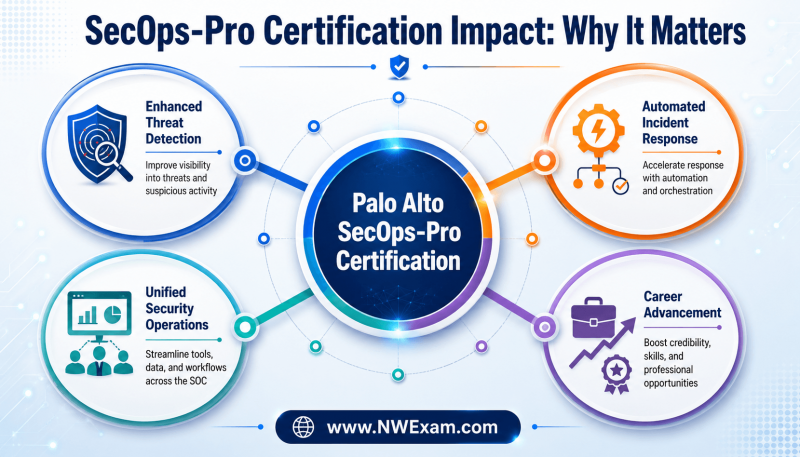
The Palo Alto SecOps-Pro certification validates a professional's advanced skills in operating and optimizing Palo Alto Networks security platforms, specifically Cortex XDR, Cortex XSOAR, and Cortex XSIAM. It confirms expertise in threat detection, incident response, security automation, and unified security operations management.
2. Is hands-on experience crucial for passing the SecOps-Pro exam?
Yes, hands-on experience is highly crucial. The exam is scenario-based and heavily emphasizes the practical application of Palo Alto Networks security solutions. Memorizing theoretical concepts alone is insufficient; candidates need to understand how to configure, operate, and troubleshoot these products in real-world security scenarios.
3. How important are Palo Alto Networks' official resources for preparation?
Official Palo Alto Networks resources, including training courses, product documentation, and technical guides, are paramount. Vendor resources are highly reliable. They provide current and comprehensive information. This is crucial for mastering the functionalities and best practices assessed in the exam.
4. What is the recommended study approach to avoid common pitfalls?
A recommended study approach involves a balanced mix of theoretical study, extensive hands-on lab practice, and regular use of practice tests. Focus on understanding the interoperation of Cortex XDR, XSOAR, and XSIAM, manage your study time effectively, and use official resources as your primary source of truth. Avoid shortcuts like brain dumps.
5. What kind of career opportunities can this certification unlock?
The Palo Alto SecOps-Pro certification can unlock advanced career opportunities in security operations, such as Senior Security Operations Center (SOC) Analyst, Incident Responder, Threat Hunter, Security Engineer, or Automation Engineer. It signals to employers a high level of proficiency in modern security operations using industry-leading tools.
- SecOps-Pro |
- SecOps-Pro Certification Mock Test |
- Palo Alto SecOps-Pro Certification |
- SecOps-Pro Mock Exam |
- SecOps-Pro Practice Test |
- Palo Alto SecOps-Pro Primer |
- SecOps-Pro Question Bank |
- SecOps-Pro Simulator |
- SecOps-Pro Exam Questions |
- Palo Alto SecOps-Pro Questions |
- Palo Alto SecOps-Pro Practice Test |
- Palo Alto Networks Certified Security Operations Professional |
- SecOps-Pro Syllabus |
- SecOps-Pro Books |
- SecOps-Pro Certification Cost |
- SecOps-Pro Certification Syllabus |
- Palo Alto SecOps-Pro Training |
- Palo Alto SecOps-Pro Books |
- SecOps-Pro Sample Questions |
- Palo Alto SecOps-Pro Practice Test Free |
- SecOps-Pro Certification Questions and Answers |
- SecOps-Pro Certification Sample Questions


